
Getting Through Winter in Japan: Temperatures and Snow by Region, Clothing, Heating and Condensation, Frozen Pipes, Heat Shock and Influenza
Published: · Updated:
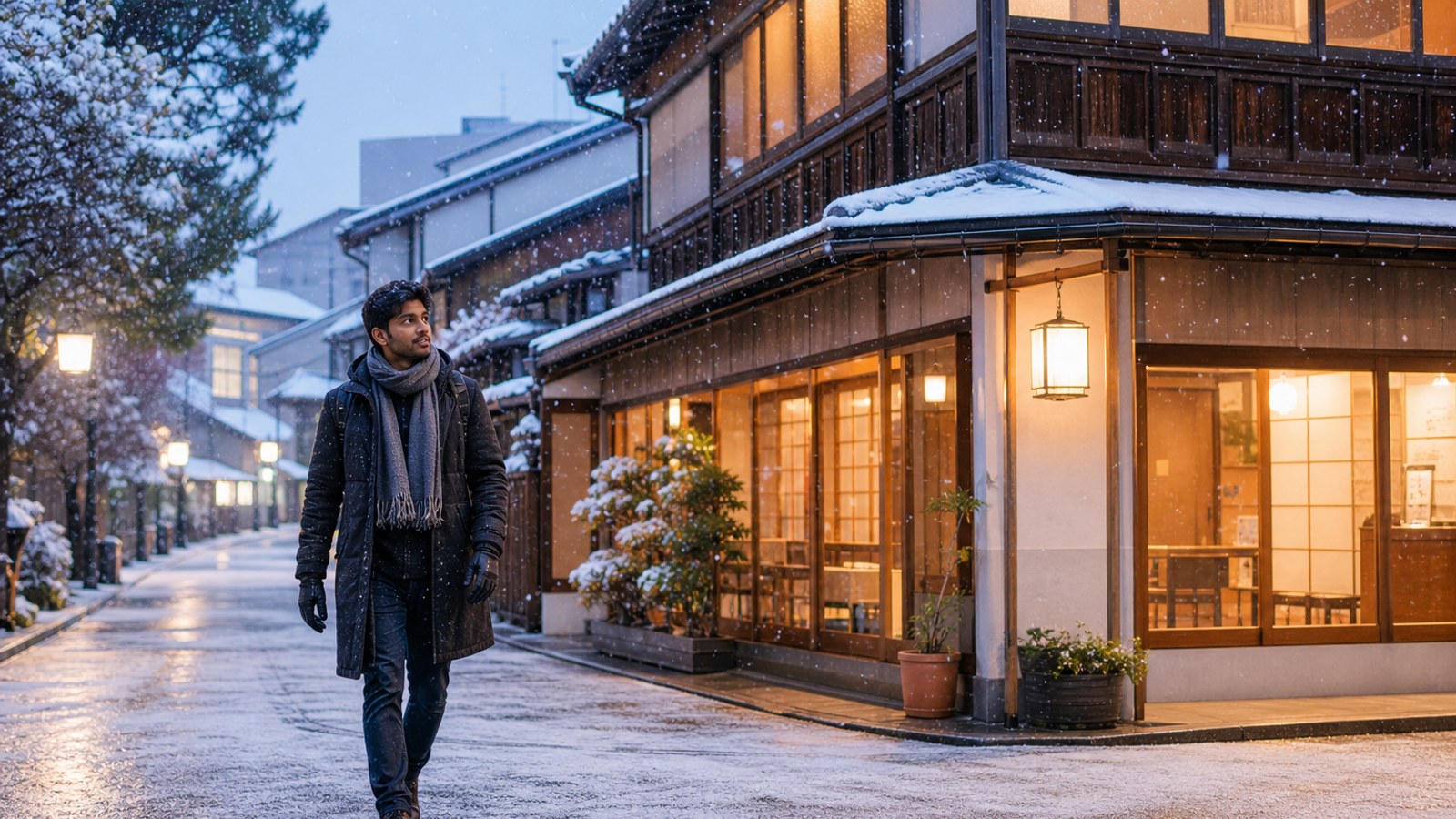
How cold is winter in Japan for someone from Nepal? The answer is that it differs greatly depending on where you live. In Sapporo, in Hokkaido, many days in January stay below freezing even in the daytime, and snow piles up. In Tokyo and Osaka, snow is rare, but mornings and nights are cold. This guide compares winter in different regions using the Japan Meteorological Agency (JMA) normals. It then explains, based on official sources, how to think about clothing, heating and condensation, frozen water pipes, snowy roads and looking after your health.
We checked the official pages listed below on 9 November 2026. The temperature and snow figures in this guide are JMA normals (the average of the 30 years from 1991 to 2020). In JMA's tables, the statistical period and the number of years of data may differ depending on the element. They are not a forecast for this year's weather. Actual temperatures and the amount of snow differ greatly from year to year. The advice on choosing clothes and belongings is a guideline from this guide. It is not an official rule. Check your school's information, and also use what seniors living in the same area tell you. For the full list of things to bring, see the what to pack guide. For disasters and emergencies, see the emergency and disaster guide.
Winter temperatures by region (JMA normals)
The table below lists winter temperatures for major cities from the JMA normals (values by year and month). The unit is °C. "Daily maximum" is the average of the highest temperature of each day, and "daily minimum" is the average of the lowest temperature of each day. The daily minimum usually occurs around dawn.
| City | December average | January average | January daily maximum | January daily minimum | February average |
|---|---|---|---|---|---|
| Sapporo (札幌) | -0.9 | -3.2 | -0.4 | -6.4 | -2.7 |
| Sendai (仙台) | 4.5 | 2.0 | 5.6 | -1.3 | 2.4 |
| Nagano (長野) | 2.3 | -0.4 | 3.8 | -3.9 | 0.4 |
| Tokyo (東京) | 7.7 | 5.4 | 9.8 | 1.2 | 6.1 |
| Nagoya (名古屋) | 7.2 | 4.8 | 9.3 | 1.1 | 5.5 |
| Osaka (大阪) | 8.7 | 6.2 | 9.7 | 3.0 | 6.6 |
| Fukuoka (福岡) | 9.1 | 6.9 | 10.2 | 3.9 | 7.8 |
This table shows the following.
- In Sapporo, even the average daily maximum in January is below freezing (-0.4℃).
- In Tokyo, Nagoya, Osaka and Fukuoka, the average daily minimum in January is about 1℃ to 4℃.
- Even in the same January, the average temperature in Sapporo and Fukuoka differs by more than 10℃.
For areas not in this table (Hokuriku, the Sea of Japan side of Tohoku, mountain areas and so on), you can look up the normals for where you live with JMA's "Search Past Weather Data" (過去の気象データ検索). Please check once the location of your school is decided.
Snow by region (JMA normals)
There are two snow figures. "Total snowfall depth" is the sum of the depth of snow that fell during the month. "Maximum snow depth" is the greatest depth of snow lying on the ground during the month. The unit is cm.
| City | January total snowfall depth | January maximum snow depth | February total snowfall depth | February maximum snow depth |
|---|---|---|---|---|
| Sapporo (札幌) | 137 | 76 | 116 | 95 |
| Nagano (長野) | 63 | 26 | 50 | 23 |
| Sendai (仙台) | 21 | 10 | 18 | 10 |
| Tokyo (東京) | 4 | 3 | 4 | 3 |
| Nagoya (名古屋) | 4 | 3 | 5 | 3 |
| Osaka (大阪) | 0 | 0 | 1 | 1 |
| Fukuoka (福岡) | 1 | 1 | 1 | 1 |
In Sapporo, the normal number of snow days is 29.1 days in January and 25.3 days in February, so it is a region with many snowy days. The normal maximum snow depth in February is 95 cm. In Tokyo, Nagoya, Osaka and Fukuoka, on the other hand, the normals show that almost no snow settles. However, even when the normal is small, some years have heavy snow. In places not used to snow, such as Tokyo, even a little snow can delay trains and make roads icy and slippery (this is a guideline from this guide).
About comparing with Nepal
Nepal's Department of Hydrology and Meteorology (DHM) publishes a monthly Preliminary Precipitation and Temperature Summary, and it uses a comparison with the 1991 to 2020 normals. However, in this research, we could not confirm in official materials a table of winter normals for individual stations such as Kathmandu. For this reason, this guide does not compare the temperatures of Kathmandu and Japanese cities with numbers. Some travel sites on the internet give numbers, but their sources and periods differ and the values are not consistent.
If you want to compare, look for official materials on the climate services page of the Nepal DHM. It is also useful to ask seniors who are already in Japan, "How cold is winter in the town where you live?"
How to think about clothing (guideline)
From here on, these are not official rules but guidelines from this guide.
- Dress in layers. In winter in Japan, it is cold outside, but it can be warm inside trains, classrooms and shops. Layers of thin clothes are easier to adjust because you can put them on and take them off easily.
- Protect your neck, hands and feet outside. A scarf, gloves, a hat and thick socks make a big difference to how cold you feel.
- Have one jacket that keeps out wind, rain and snow. In regions with a lot of snow, such as Sapporo, you also need shoes that snow does not soak through easily.
- Choose shoes with non-slip soles. This matters when you walk on snowy or frozen roads (see "Snowy and icy roads" below).
- You can also buy things after you arrive in Japan. You do not need to bring all your expensive winter clothes. It is safer to check how cold your school's area is before deciding how much to buy. Some areas get cold from November, right after people arrive in October, so please also see the intake timing guide.
Heating and utility costs
Heating in Japanese homes
In Japanese homes, heating equipment is often used separately in each room (this is a guideline from this guide, and it differs by building). There are many kinds, such as air conditioners, kerosene heaters, electric heaters and kotatsu. What a room has and which heaters you may use depend on the housing and the contract. Once you have decided where to live, check with the management company (see the housing guide).
Keeping utility costs down
According to material from Government of Japan Public Relations Online, utility costs are high in winter because the difference between outdoor temperature and room temperature is large and the nights are long. Heating, including air conditioners in winter, accounts for about 30% of a household's electricity use. It is also said that when a room is heated, about 60% of the heat in the home escapes through openings such as windows. As ways to save that are not hard to do, the following are introduced.
- Set the air conditioner to about 20℃.
- To adjust the room temperature, do not switch the unit on and off often; use the air conditioner's automatic mode.
- In the daytime, open the curtains to let in sunlight, and at night use thick curtains so that heat does not escape.
- Put insulating sheets or film on the windows.
Charges differ depending on the company you contract with, the region and how much you use. This guide does not list specific amounts. Check your monthly bill together with what the housing management company and seniors tell you.
Kerosene heaters and carbon monoxide poisoning
When you use kerosene heaters, gas or kerosene heating equipment, or water heaters, you need to ventilate often. The National Institute of Technology and Evaluation (NITE) warns that in winter ventilation tends to be insufficient because of the cold, and that without ventilation there is a risk of carbon monoxide poisoning. It also advises not to block the air supply and exhaust outlets of water heaters and bath boilers, to check that these outlets are not blocked when snow has piled up, and not to use a portable generator indoors during a power outage. Sleeping in a closed room with a heater on is dangerous (this is a guideline from this guide). If you do not know how to use a heater, ask the management company or your school.
Condensation and mold
In a winter room, water drops can form on windows and walls. This is called condensation (結露). According to material from the City of Sapporo, condensation is the phenomenon where air touches a cold window or wall and the moisture in the air turns into water drops. Condensation causes mold and can also damage the home. Mold also grows in places such as closets, bathrooms and toilets.
These are points to watch, taken from the City of Sapporo material.
- When the air in a room stagnates, condensation forms easily in places such as corners of the room. Be careful how you place furniture and belongings.
- If you heat only the room where people are, the warm air flows into cold unheated rooms, is cooled, and condenses.
- Inside closets and behind furniture, air does not flow easily and the spots get cold, so condensation forms easily.
- Always ventilate while cooking and after bathing.
- If mold appears, wipe it off gently with a well-wrung cloth. If you wipe with a dry cloth or suddenly use a vacuum cleaner, the spores scatter.
The basics are to wipe the windows and let air move through. Because heating dries the air, you may want to dry a lot of laundry indoors or humidify too much, but this can increase condensation (this is a guideline from this guide). When you use detergent, do not mix chlorine-based detergents with acidic detergents (see also "chlorine-based detergents" in the what to pack guide). If the mold is bad, do not try to deal with it on your own; contact the management company.
Frozen water pipes
According to material from the Ministry of Land, Infrastructure, Transport and Tourism, when the temperature falls below freezing, the water in water pipes can freeze, so that no water comes out, or the pipes can burst and leak. Take particular care in these cases.
- When the lowest temperature is -4℃ or below.
- When you do not use water for a long time, such as before going to bed or when you leave home for a trip.
- Water pipes that run along the outer wall of a building.
- Water pipes in shaded north-facing places or places exposed to strong wind.
To prevent freezing, wrap the water pipes with insulation so that they do not touch the outside air directly. If the water has frozen and no water comes out, wait until it thaws naturally, or wrap a towel or similar around the frozen part and pour lukewarm water on it slowly. Pouring boiling water on it may make the pipe burst. If a pipe bursts, close the main valve to stop the water and contact the water supplier. Do not try to repair it yourself, and also contact your housing management company right away.
Snowy and icy roads
When walking
In the City of Sapporo Fire Department's fiscal 2025 (Reiwa 7; November 2025 to March 2026) "Summary of ambulance transports for falls on snowy roads," a total of 2,064 people were taken by ambulance in Sapporo alone. Of these, 1,646 people (79.7%) fell on the road, which is most of them. Not only in regions with a lot of snow but also in regions not used to snow, icy roads are dangerous (this is a guideline from this guide).
- Roads freeze easily on the morning after snow and at night (guideline).
- Do not hurry, and leave with time to spare (guideline).
- Choose shoes with non-slip soles (guideline).
- Crosswalks, station entrances, shaded places and bridges are especially slippery (guideline).
- Keep your hands out of your pockets, and put your belongings in a backpack so that your hands are not full (guideline).
Bicycles and part-time work
On snow and icy roads, bicycles fall over easily (guideline). On such days, it is safer not to ride, but to walk and push the bicycle, or to take a train or bus. For the rules for bicycles, see the cycling and driving guide. On snowy days, leave plenty of time for your trips to and from part-time work too. If you might miss work, contact your workplace early (see the part-time work guide).
Snow removal (snow shoveling)
Depending on the rules of the housing, the residents may have to remove snow in front of the apartment and around the housing. The Consumer Affairs Agency warns that snow removal should be done without overexerting yourself and with two or more people. NITE reports that snow removal accidents (a body being caught in a machine, falling from a ladder, falling from a roof and so on) happen in winter. Do not remove snow from a roof or use a snow blower if you are inexperienced and by yourself. Ask the management company what to do.
Looking after your health in winter
Heat shock (temperature difference when bathing)
The Consumer Affairs Agency reports that drowning accidents in the bathroom increase as winter comes. This material focuses mainly on accidents among older people, but the large difference in temperature between a cold changing room and warm bath water is a strain on the body, and it is something to be careful about regardless of age (this is a guideline from this guide). The points the Consumer Affairs Agency lists are as follows.
- Warm the changing room and the bathroom before bathing.
- As a guideline, keep the water at 41 degrees or lower and soak for up to 10 minutes.
- Do not stand up suddenly from the bathtub.
- Avoid bathing right after eating, after drinking alcohol, or after taking medicine.
- Tell the people you live with before you bathe.
Influenza
According to the Ministry of Health, Labour and Welfare Q&A, the influenza season in Japan is normally December to March. However, the start of the season changes from year to year; in 2024 (Reiwa 6) it spread earlier than usual and peaked in December. Government of Japan Public Relations Online explains that it usually peaks in January and February. In Japan, about 10 million people, roughly 1 in 10, are said to be infected each year. The basics of preventing infection are as follows.
- Wash your hands often, for example when you come home from outside.
- Wear a mask when you go to crowded places during the season.
- Keep the humidity at 50% to 60% so that the room does not become too dry.
- Consider getting vaccinated before the season. Cost and places where you can get it differ by region, so ask the office of the city, ward, town or village where you live, or a medical institution.
If you have symptoms such as a high fever that lasts, difficulty breathing or confusion, see a medical institution early. Government of Japan Public Relations Online explains that if you start taking an influenza drug within 48 hours of onset, the period of fever becomes shorter. For how to see a doctor, see the guide to seeing a doctor.
Checklist before winter starts
- I checked the December to February normals for the area of my school on the JMA site.
- I prepared clothes I can layer, a jacket, a scarf, gloves and non-slip shoes (guideline).
- I checked with the management company which heaters my housing has and which ones I may use.
- I know how to ventilate if I use a kerosene heater or similar.
- I know how to deal with condensation on windows and in rooms (ventilating, wiping, moving the air).
- I know the precautions for water pipes on days when there is a risk of freezing.
- I know how to walk and the precautions for bicycles on snowy days and icy mornings.
- I know to warm the changing room before bathing, and how to prevent influenza with hand washing, masks and vaccination.
Frequently asked questions
Which is colder, winter in Nepal or winter in Japan?
It depends on the region, and this guide cannot compare them with numbers. In the materials of Nepal's DHM, we could not confirm a table of winter normals for places such as Kathmandu. On the Japanese side, as in the tables above, the January average is -3.2℃ in Sapporo and 5.4℃ in Tokyo, for example.
Does it snow in Tokyo and Osaka?
According to the normals, the amount of snow is very small. The maximum snow depth in January is 3 cm in Tokyo and 0 cm in Osaka. However, it differs from year to year, and some years have heavy snow. When it snows, trains may be delayed and roads may become slippery, so please be careful (this is a guideline from this guide).
Is it normal to have a room with no heating?
It depends on the housing. Some rooms have an air conditioner and some do not. When you choose housing, check whether heating equipment is included. Ask the management company about the contract terms and which equipment you may use.
What should I do if I feel unwell in winter?
If you have a high fever, difficulty breathing or confusion, see a medical institution early. In an emergency, call an ambulance on 119 (see the emergency and disaster guide).
What to do next
Once the area of your school is decided, check the winter temperatures and snow in the JMA normals. Then prepare your luggage with the what to pack guide, and check heating and the contract with the housing guide. After you arrive, please also see the guide to the first 7 days in Japan. You can contact this site, but we do not guarantee admission or a visa. This site is free to use.
Sources
- Japan Meteorological Agency: Normals (values by year and month), Sapporo
- Japan Meteorological Agency: Normals (values by year and month), Sendai
- Japan Meteorological Agency: Normals (values by year and month), Nagano
- Japan Meteorological Agency: Normals (values by year and month), Tokyo
- Japan Meteorological Agency: Normals (values by year and month), Nagoya
- Japan Meteorological Agency: Normals (values by year and month), Osaka
- Japan Meteorological Agency: Normals (values by year and month), Fukuoka
- Nepal Department of Hydrology and Meteorology (DHM): Climate Services
- Nepal Department of Hydrology and Meteorology (DHM): Preliminary Precipitation and Temperature Summary, December 2025
- Government of Japan Public Relations Online: Energy-saving points by room - keeping down winter utility costs that tend to rise
- Ministry of Health, Labour and Welfare: Influenza Q&A (fiscal 2025)
- Government of Japan Public Relations Online: Points to prevent influenza infection - hand washing, masks and cough etiquette
- Consumer Affairs Agency: Beware of accidents among older people that increase at the year end and New Year
- Ministry of Land, Infrastructure, Transport and Tourism: Beware of frozen water pipes
- National Institute of Technology and Evaluation (NITE): Beware of winter fatal accidents - 19 with snow blowers, 17 from carbon monoxide poisoning
- City of Sapporo: Condensation and mold measures
- City of Sapporo Fire Department: Fiscal 2025 summary of ambulance transports for falls on snowy roads
- Immigration Services Agency of Japan
- Study in Japan (JASSO)