
What to Pack for Japan: Carry-On and Checked Bags, Restricted Items, Medicine, Cash, Power Banks and Electronics
Published: · Updated:
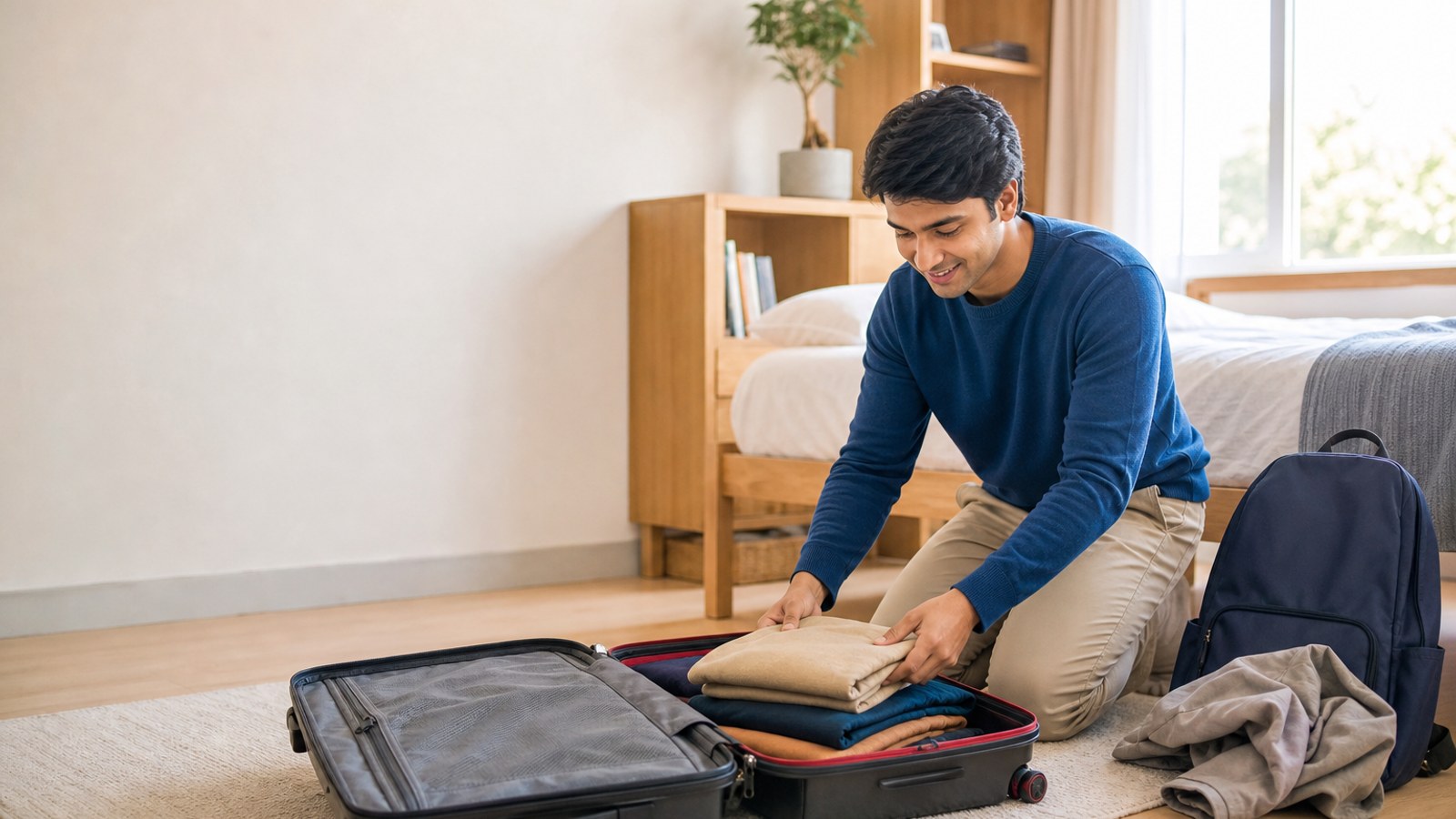
What should you put in your bags for Japan, and what must you leave out? When you pack, the hardest part is knowing which items you cannot bring and which items you must declare. This guide splits your luggage into what you carry on board and what you check, and explains the restrictions and procedures, based on official information.
We checked the official pages listed at the bottom on 8 November 2026. Baggage weight, size and piece limits depend on your airline and your ticket type. This guide does not give figures for them. Aviation safety rules can also change. Before you leave, check the latest information from your airline and your school. The advice on clothes and daily items is a "guideline" from this guide, not an official rule.
First, split your luggage into three
It is easier to pack if you think in three groups.
| Group | What goes in |
|---|---|
| Carry on board (hand luggage) | Documents, money, smartphone, chargers, power banks, daily medicine, one change of clothes |
| Check in (suitcase) | Clothes, shoes, towels, toiletries, spare medicine, items with a lot of liquid |
| Buy or send after you arrive | Bedding, large appliances, heavy items (ask your school and older students) |
Put things you cannot afford to lose in your carry-on. Checked bags sometimes arrive late. It is wise to keep one change of clothes and any medicine you need in your hand luggage (a guideline from this guide).
Documents and money for your hand luggage
| What to bring | Notes |
|---|---|
| Passport | Keep it where you can take it out quickly at immigration |
| Visa and documents your school told you to bring | Follow your school's instructions. See also the immigration guide |
| Visit Japan Web QR code | Register before you leave and be ready to show it on arrival. Save a screenshot as a backup and charge your phone well |
| A note in Japanese with your school's name, address and nearest station | You can show it to people if you need help |
| Contact details for your school and your housing manager | Write them on paper too, in case your phone does not work |
| A small amount of Japanese yen in cash | For transport and food on your first day. Whether credit cards work depends on the shop or company |
| ID photos | You may need them for procedures at the city office or school (a guideline from this guide) |
Take photos or copies of your passport and documents and keep them somewhere separate from the originals. If you lose them, the procedures become easier (a guideline from this guide).
Cash and securities: declare if the total value is over 1 million yen
According to Japan Customs, if the total of cash, cheques, promissory notes and securities is over 1 million yen in value, or if you carry gold bullion (purity 90% or more) of more than 1 kg, you must submit a "Declaration of Carrying of Means of Payment" to customs, in addition to the "Customs Declaration." If you fail to declare, or make a false declaration, you can face penalties of up to 5 years in prison or a fine (the customs FAQ states imprisonment of up to 5 years, a fine of up to 10 million yen, or both).
Consider using a safe method such as a bank transfer instead of carrying large sums. For how to pay tuition and living costs, see the cost guide and your school's instructions.
What you can carry on board and what you can check
Power banks
You must not put a power bank (lithium battery) in your checked luggage. Carry it on board. From 24 April 2026 the Ministry of Land, Infrastructure, Transport and Tourism added these rules:
- You may carry up to 2 power banks (160 Wh or less) on board.
- Charging a power bank on board, and charging other devices from a power bank, are prohibited.
Airlines may explain how and to which flights this rule applies in different ways. Check the capacity (Wh) of your power bank and ask your airline.
The 100 ml liquid rule
According to the Ministry of Land, Infrastructure, Transport and Tourism, the limit on liquids in the cabin applies to international flights departing from Japanese airports. The rules are:
- Liquids, gels and sprays must be in containers of 100 ml or less each.
- Put them in a transparent, zip-top bag of 1 litre or less. One bag per person.
- Liquids over 100 ml can be carried if you put them in a suitcase you check in.
- Medicines and similar items are an exception, in the amount needed on board.
Japan's limit does not apply to flights from Nepal to Japan. The rules of the country of departure apply. However, Japan's limit does apply when you transfer at a Japanese airport and when you fly home from Japan. Ask your airline about the rules at the airport in Nepal.
Spray cans, cosmetics and chlorine-based cleaners
The ministry's "typical examples of dangerous goods" (updated 24 April 2026) sets quantities for cosmetics, medicines and spray cans. For example, spray cosmetics, medicines and other spray cans are limited to 0.5 litres (or 0.5 kg) per container and 2 litres (or 2 kg) in total per person. Bleach, mould removers, and cleaners labelled "chlorine-based" or "do not mix" cannot be carried on board or checked. The rules differ by item. If you are unsure, ask your airline or leave the item at home.
Taking medicine
The Ministry of Health, Labour and Welfare gives this advice for carrying medicine:
- Do not bring more than you think you will need for the trip.
- Keep medicine in its original container or packet.
- It is a good idea to carry a document that explains the medicine you take and the illness or symptoms (one written in English can be useful; a guideline from this guide).
- The person who will use the medicine should carry it in person, not send it by post.
Prescription psychotropic medicines (for example sleeping pills and anti-anxiety medicines) can be brought in by the patient for their own treatment. However, if the amount is more than one month's supply, or the medicine is an injection, you need documents such as a copy of the prescription proving that it is needed for your own treatment. Prescription narcotics need prior permission from the Narcotics Control Department of the Regional Bureau of Health and Welfare (地方厚生局 麻薬取締部).
If you take a medicine regularly over a long period, talk to your doctor and your school before you go. This guide cannot tell you whether you can get the same medicine at a hospital in Japan.
Customs: the duty-free allowance and declaring
According to Japan Customs, the duty-free allowance is as follows (per person aged 20 or over).
| Item | Duty-free allowance |
|---|---|
| Alcohol | 3 bottles (760 ml each) |
| Cigarettes | 200 cigarettes (heated tobacco, cigars and others differ by type) |
| Perfume | 2 ounces (1 ounce is about 28 ml) |
| Other goods | Up to 200,000 yen in total overseas market value. Goods whose total overseas market value per item category is 10,000 yen or less are in principle duty-free and are not counted in the 200,000 yen |
- People under 20 cannot bring alcohol or tobacco duty-free.
- If your other goods total more than 200,000 yen, items are chosen so that goods up to 200,000 yen are duty-free, and the rest are taxed (customs chooses in the traveller's favour). However, any single item worth more than 200,000 yen is taxed on its full value.
- Commercial goods and samples are not covered by the duty-free allowance.
When you enter Japan, you submit a Customs Declaration for Baggage Carried and Unaccompanied Articles to customs. You can also enter your declaration in advance in Visit Japan Web and use the QR code (see the immigration guide). If you send luggage separately (unaccompanied articles), you also need to declare it.
Food
Nepali food (meat products, spices and so on) is covered by animal and plant quarantine rules, and much of it cannot be brought in. Breaking the rules carries heavy penalties. Be sure to check the food guide. If you are unsure about an item, the safe choice is not to bring it.
Electrical appliances
When you bring electrical appliances, check the voltage and frequency.
- Household electricity in Japan comes in 100 V and 200 V. In the example of the Tokyo Electric Power supply terms, the standard voltage is 100 V or 200 V. Ordinary household sockets are usually 100 V, and some appliances such as air conditioners may use 200 V.
- The frequency is 50 Hz in eastern Japan and 60 Hz in western Japan, divided at the Fuji River in Shizuoka Prefecture (Federation of Electric Power Companies of Japan).
- Appliances carry a label such as "INPUT" with the voltage (V). An appliance labelled "100-240V" can also be used at 100 V. An appliance made only for the voltage in Nepal may not work in Japan, or may break.
- Socket shapes also differ by country. Check before you go whether you need a plug adapter.
Heat-producing appliances such as hair dryers are dangerous if the voltage does not match. It is often safer and easier to buy them in Japan (a guideline from this guide). For laptop and phone chargers, check for the "100-240V" label.
Clothes and daily items (guideline)
From here on, these are not official rules but guidelines from this guide. Follow your school's instructions and the advice of older students first.
- Pack few clothes. You can buy them in Japan. Enough for the day you arrive and a few days after is a good start.
- Match the season. Japan has four seasons, and temperatures differ by region. Whether you start in April or October, look up the temperatures where your school is, at the time you start, and choose clothes to match. In regions with cold winters you need warm clothes such as a coat. You can also buy them after you arrive, so you do not need to bring expensive items.
- Comfortable shoes. In Japan you often walk to and around stations.
- You take off your shoes when you enter a home. Shoes that are easy to take off, and slippers (or socks) for indoors, are handy.
- Japanese study tools. Your school may specify dictionaries and textbooks. Ask your school before you buy.
Things you do not need to bring
You can often buy bedding, large appliances and heavy dishes in Japan. What comes with your housing, however, differs from room to room. Once your housing is decided, ask the management company or your school (see the housing guide).
Sending large luggage ahead
If your luggage is heavy, you can send it by delivery from the airport to your school or housing. For the delivery service at Narita Airport, see the Narita guide. Luggage you send may also need a customs declaration.
Checklist for the day before you leave
- Passport, visa and school documents are in your hand luggage.
- You have registered with Visit Japan Web and can show the QR code. You also saved a screenshot as a backup.
- Power banks are in your carry-on, and you have checked their capacity (Wh).
- Liquids over 100 ml are in your checked bag.
- Daily medicine is in its original container and also in your hand luggage.
- You have checked the food rules. You have not packed items you are unsure about.
- You have checked that your cash and securities do not exceed 1 million yen in value.
- You have written your school's address and contact details on paper.
Frequently asked questions
How many kilograms can I bring?
It depends on your airline and ticket type. We could not confirm figures for this guide. Check the latest information from the company you bought your ticket from.
Can I put a power bank in my checked suitcase?
No. The Ministry of Land, Infrastructure, Transport and Tourism prohibits putting power banks in checked luggage. Always carry them on board.
Can I buy my medicine in Japan?
Some medicines are sold at pharmacies. However, this guide cannot confirm which medicines are available with the same ingredients. If you take a medicine regularly, talk to your doctor.
Can I bring souvenirs?
Alcohol, tobacco and other goods have duty-free allowances. Food is covered by quarantine rules. Check the "Customs" and "Food" sections above.
Next steps
Once you have packed, check the immigration guide for the flow at the airport. For after you arrive, see the Narita guide and the first 7 days guide. You can contact us, but we do not guarantee admission or a visa. This site is free to use.
Sources
- Ministry of Land, Infrastructure, Transport and Tourism: New rules for carrying power banks on board (14 April 2026)
- Ministry of Land, Infrastructure, Transport and Tourism: Q&A on the limit on liquids in the cabin of international flights
- Ministry of Land, Infrastructure, Transport and Tourism: Typical examples of items restricted in cabin or checked baggage
- Japan Customs: Duty-free allowance for travellers
- Japan Customs: Procedures for carrying means of payment in and out
- Japan Customs: Customs procedures on entry
- Ministry of Health, Labour and Welfare: Procedures for carrying medicines abroad and into Japan
- Ministry of Health, Labour and Welfare, Narcotics Control Department: For those carrying narcotics and stimulant raw materials in and out of Japan
- Ministry of Agriculture, Forestry and Fisheries, Animal Quarantine Service: About meat products as souvenirs
- Ministry of Agriculture, Forestry and Fisheries, Plant Protection Station: Travellers (carried items)
- Federation of Electric Power Companies of Japan: Frequency of electricity in Japan (Enelog)
- Tokyo Electric Power: Supply terms (standard voltage and frequency in the TEPCO area)
- Immigration Services Agency of Japan
- Study in Japan (JASSO)