
Finding Housing in Japan as a Student: Dormitory vs Private Apartment, Upfront Costs and Guarantors
Published: · Updated:
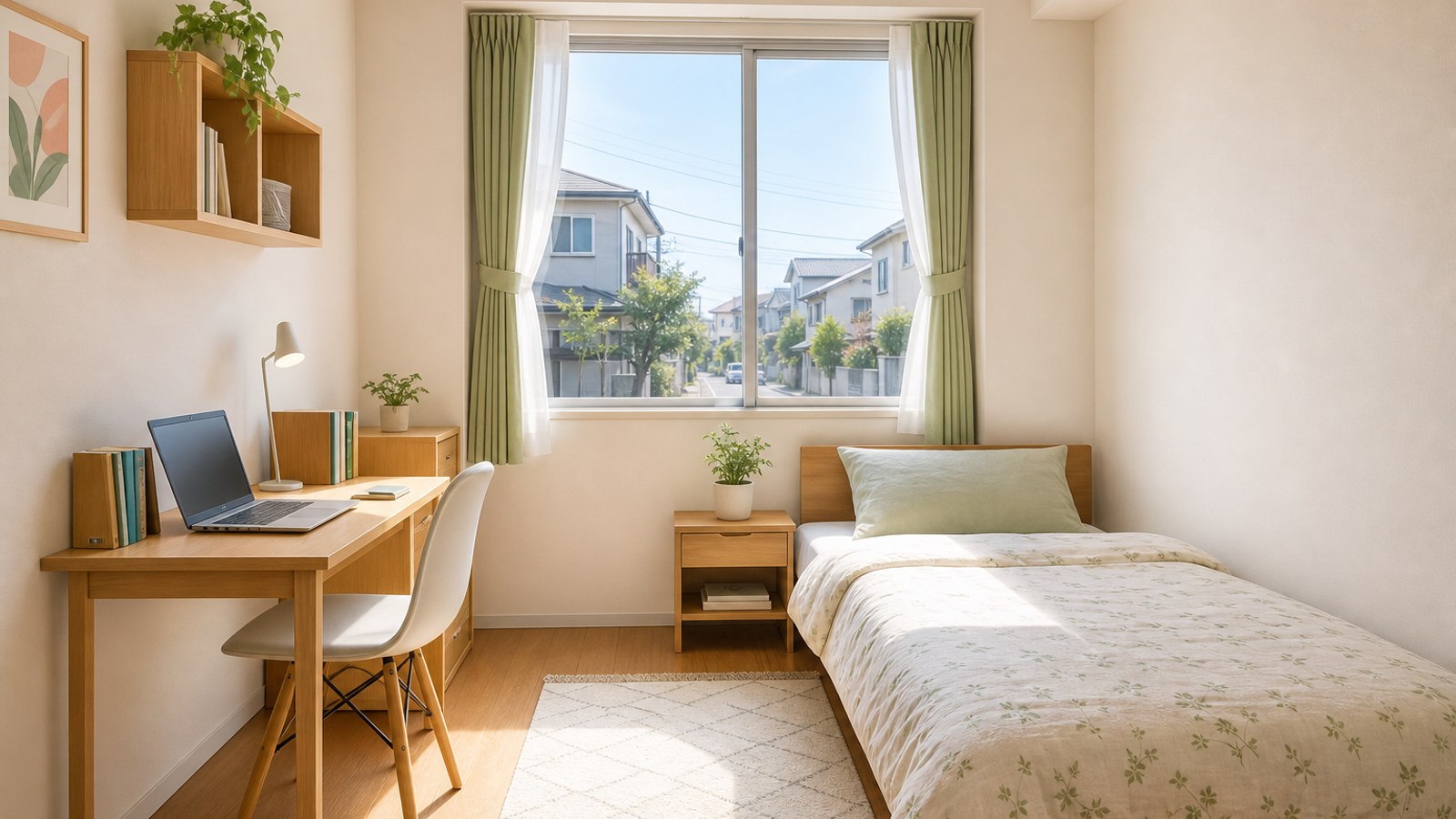
One of the first things you must decide in Japan is where to live. Housing is one of the largest items in your monthly living costs, and you need it as soon as you arrive. This guide explains your options, the costs, how guarantors work, and what to think about when searching, using official information.
We checked the official pages listed at the bottom on 7 November 2026. Rent and upfront costs differ greatly by region, property and school. Use this guide as a rough guide and confirm the latest details with your school and a real estate agent before you decide.
Your options
According to Study in Japan (JASSO), about 70% of international students live in private houses or apartments. The two main options are:
| Student dormitory | Private apartment | |
|---|---|---|
| Run by | Local governments and schools (such as universities) | Real estate companies and landlords |
| Good points | Lower rent and expenses than an apartment. May come with furniture and appliances | Freedom to live your own way. You learn to manage your own money |
| Things to watch | Limited rooms. Rules such as curfews and wake-up times. Kitchen, toilet and bathroom may be shared | High upfront costs. Complicated contracts. You need to prepare furniture and appliances yourself |
The student dormitory of the JASSO Tokyo Japanese Language Education Center is given as 28,000 yen a month. The JASSO housing page introduces this as an example. Dormitories at other schools differ in price and conditions, so ask your school.
Rent guide
These are average rents by region from JASSO's 2023 survey of privately financed international students.
| Region | Average monthly rent |
|---|---|
| National average | 41,000 yen |
| Tokyo | 57,000 yen |
| Kanto | 51,000 yen |
| Kinki | 40,000 yen |
| Chubu | 30,000 yen |
| Kyushu | 29,000 yen |
| Hokkaido | 34,000 yen |
| Shikoku | 27,000 yen |
| Tohoku and Chugoku | 26,000 yen |
JASSO explains that in regional areas you may find apartments for about 30,000 to 40,000 yen a month, and that in Tokyo looking for one within 60,000 yen is a reasonable target. These are guides. Actual rent changes with the location, size and distance from the station.
Upfront costs
With a private apartment, you need a considerable amount of money in advance when you move in. The main items JASSO lists are:
- Deposit (shikikin): Money, usually several months' rent, that you leave with the landlord.
- Key money (reikin): A gift payment to the landlord.
- Agent fee: A fee paid in advance to the real estate agent.
- Furniture and appliances: In many cases you need to buy them yourself.
Dormitories are said to avoid costs such as renewal fees. Amounts differ for both dormitories and apartments by property and school, so check with your school and the real estate agent for the total you need to pay when you move in, not just the monthly rent.
For more on thinking about costs, see the cost guide.
Guarantors
When you rent an apartment, a joint guarantor is generally required. A joint guarantor may be asked to pay if you cannot pay the rent or if repairs to the room are needed.
For international students who have few contacts in Japan, there are options such as these (JASSO):
- School staff act as joint guarantor: Staff in the student office or teaching staff may act as your joint guarantor.
- Use a guarantee company: If you sign a contract and pay a guarantee fee, you may not need a joint guarantor.
- Comprehensive Renters' Insurance for Foreign Students: A system for international students run by JEES (Japan Educational Exchanges and Services). It includes cover for accidents such as fires and is also used to lighten the burden on your joint guarantor. The system can be used when your school has joined as a "cooperating school" (JEES). Ask your school about the scope of cover and whether you can use it.
How far a school will support you (as a guarantor, by introducing a guarantee company, by introducing properties) differs by school. Ask your school before you go to Japan.
Order and priorities when searching
JASSO shows the following approach.
- When to start: Start looking once you receive your school's notice of admission.
- Where to look: The school's international student office, searching online, and local real estate agents.
- Decide your priorities: Think in this order: rent and upfront costs, distance and travel time to school, size and facilities, and the surrounding area (stations, shopping, etc.).
In big cities such as Tokyo, rent is higher than in regional areas, and it can be hard to find housing near your school, which can raise your commuting costs.
What to decide before you go
- Does the school have a dormitory? When can you move in, and how do you apply?
- Will the school help with introducing housing or with a guarantor?
- Where will you stay for the first few days? If you arrive before your housing is decided, talk to your school.
- Within 14 days after establishing your address in Japan (the day you settle on where you live), take your residence card to the municipal office and report your address. The procedure is explained in the guide to procedures after you arrive.
Contract and living cautions
- Contracts are complicated. Do not sign if you do not understand the contents. Ask a school staff member or the real estate agent about anything you do not understand.
- Mind the noise. Apartments in Japan are close together, so noise, especially at night, is a common cause of trouble with neighbors.
- Garbage rules are strict. Separate your garbage and put it out at the designated place, on the designated day and time.
Frequently asked questions
Which is better, a dormitory or a private apartment?
A dormitory costs less and may come with furniture, but rooms are limited and there are rules. An apartment gives you freedom, but upfront costs are high and the contract is complicated. Some people start in a dormitory just after arriving and move to an apartment once they are used to life. Ask your school whether there is a dormitory and what the conditions are.
How much is rent?
In JASSO's 2023 survey, the national average is 41,000 yen a month and Tokyo is 57,000 yen. In regional areas there are apartments for around 30,000 to 40,000 yen. It differs greatly with the location and size.
How much are the deposit and key money?
It depends on the property. The deposit is said to be several months' rent. The JASSO page does not give amounts for key money or agent fees. Before you move in, confirm the total in writing.
Can I rent without a joint guarantor?
If school staff act as your joint guarantor, or if you use a contract with a guarantee company, you may not need a joint guarantor. Ask your school what support it offers.
Can I decide on housing in Japan before I leave Nepal?
Your school may introduce housing. However, if you cannot view the room yourself, it helps to ask a school staff member to check the contract, rent and upfront costs for you.
What to do next
To compare schools by housing conditions, check dormitories and fees in the school list. For the full process, see How to Study in Japan from Nepal, and for choosing a school, see How to Choose a Japanese Language School. If you need help, contact us. This site is free to use. We do not guarantee admission or a visa.
Sources
- Study in Japan (JASSO): Accommodation
- Study in Japan (JASSO): Living costs
- Immigration Services Agency of Japan: Reporting your address after landing (mid- to long-term residents)
- Japan Educational Exchanges and Services (JEES): Comprehensive Renters' Insurance for Foreign Students
- Immigration Services Agency of Japan
- Study in Japan (JASSO)