
Cycling Rules and Driving Licences in Japan for Students: The Blue Ticket from April 2026, Helmets, Bicycle Registration, Insurance, the International Driving Permit and Converting a Foreign Licence
Published: · Updated:
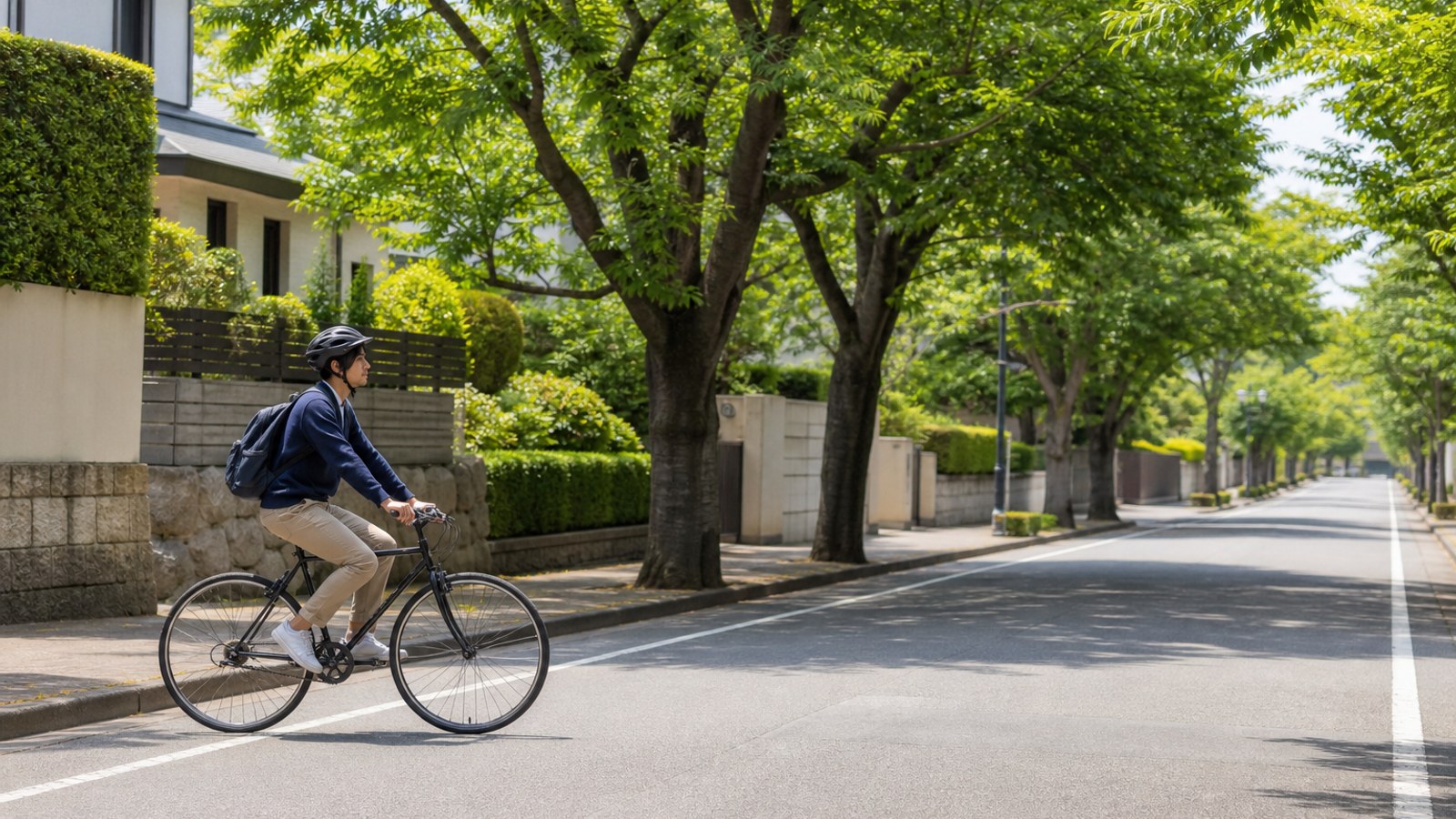
In Japan, many international students ride bicycles to get to school and to part-time jobs. But traffic rules for bicycles differ from country to country. From April 2026, a new procedure called the "blue ticket" (青切符, under the "traffic violation notification system", 交通反則通告制度) also started for bicycle traffic violations. And if you want to drive a car or motorbike, you may wonder whether you can drive with your Nepali licence as it is. This guide explains the bicycle rules first, then driving a car or motorbike, based on official information.
We checked the official pages listed below on 9 November 2026. Rules, the amounts of traffic fines and licence procedures can change when laws are revised, and they differ by prefecture. This guide only writes what we could confirm. We cannot guarantee that it is up to date. Before you ride a bicycle, and before you start any licence procedure, check the latest guidance of the National Police Agency or the police of the prefecture where you live.
A bicycle is a kind of vehicle
According to the National Police Agency's "Bicycle Rulebook" (自転車ルールブック), a bicycle is a "light vehicle" (軽車両), a kind of "vehicle" in the same group as cars. So on the road you must follow traffic rules just as cars do.
The same document says you do not need a driving licence to ride a bicycle, and you do not need a number plate. This is about the ordinary bicycles explained here. Motorised bicycles with pedals (ペダル付き原動機付自転車), electric kick scooters and similar vehicles come under different rules from bicycles, so before you buy one, check not only with the shop but also with the guidance of the National Police Agency or the prefectural police. Because of this, some people ride without knowing the rules. Some rules differ from habits in Nepal, so when you arrive in Japan, read the following sections before you start riding.
What is the blue ticket? (from April 2026)
According to the National Police Agency's rulebook, the "Act Partially Amending the Road Traffic Act" (Reiwa 6 Act No. 34) came into force on 1 April 2026 (Reiwa 8), and the procedure after a person is caught for a bicycle traffic violation changed.
The blue ticket works as follows.
- It applies to "traffic violations" (反則行為) committed by people aged 16 or older. People under 16 are not subject to the blue ticket. In many cases they receive guidance and a warning, but each case is handled individually.
- If you admit the violation, you pay a set "traffic fine" (反則金) by the deadline. It is explained that if you pay the traffic fine, the case does not go on to criminal procedure (questioning or a trial) and you do not get a criminal record.
- The National Police Agency says its approach to enforcement is the same before and after the blue ticket. When police find a violation, they basically give "guidance and a warning" on the spot. However, malicious and dangerous violations are subject to being caught.
- Drunk riding, riding after drinking alcohol, tailgating-type road rage driving (あおり運転), and causing an accident or danger by using a smartphone (using a mobile phone etc., causing traffic danger) are not handled with a blue ticket but with the same criminal procedure as before. If a traffic accident is caused by a traffic violation, that is also criminal procedure.
The National Police Agency explains that guidance and enforcement are carried out intensively in the morning commuting and school hours, when there are many accidents, and around sunset when it gets dark, in areas and on roads decided by each police station.
According to the National Police Agency's explanation, if you receive a blue ticket and admit the violation, you take a "payment slip" (納付書) to a bank or post office counter and pay the traffic fine, as a rule within 7 days from the day after you were stopped. If you did not make a provisional payment, you go to the Traffic Violation Notification Center (交通反則通告センター) on the date written on the blue ticket and receive a notice and a payment slip. If you do not pay within 10 days from the day after you received the notice, the case goes on to criminal procedure. The deadline and how to pay are written on the blue ticket and the payment slip. Do not ignore them. If you do not understand, ask a teacher at your school or a police counter.
Examples of traffic fine amounts
The main bicycle traffic violations and traffic fines written in the National Police Agency's rulebook are as follows.
| Violation | Traffic fine |
|---|---|
| Using a mobile phone etc. (holding: talking with the phone in your hand, staring at the screen in your hand) | 12,000 yen (written as the highest bicycle traffic fine) |
| Entering a level crossing whose barrier is closed (entering when the barrier is about to close or the alarm is sounding) | 7,000 yen |
| Ignoring a traffic signal | 6,000 yen |
| Violating the rules on which part of the road to use (riding on the pavement where pavement and roadway are separate, riding on the right side = wrong-way riding, etc.) | 6,000 yen |
| Not stopping at a level crossing | 6,000 yen |
| Violating the duty of safe driving (riding with no hands on the handlebars, etc.) | 6,000 yen |
| Not stopping at a designated place (not stopping at a stop sign) | 5,000 yen |
| Riding without a light (not turning on the light at night) | 5,000 yen |
| Defective bicycle brakes (no brakes, or broken brakes) | 5,000 yen |
| Carrying two people on one bicycle | 3,000 yen |
This is only part of the list. The National Police Agency says that violations not listed here can also lead to being caught. For the full list and the latest amounts, check the National Police Agency's "Bicycle Rulebook".
Basic traffic rules (the Five Rules for Safe Bicycle Use)
The National Police Agency summarises the basic bicycle rules as the "Five Rules for Safe Bicycle Use" (自転車安全利用五則).
- 1. The roadway is the rule, and keep to the left. The pavement is the exception, and pedestrians come first. On roads where pavement and roadway are separate, a bicycle in principle rides on the roadway, keeping to the left side of the road. Riding on the right side (wrong-way riding) is a violation.
- 2. At junctions, obey signals and stop signs, and check for safety. A bicycle follows the vehicle signal when it goes along the roadway, and the pedestrian signal when it goes on a pedestrian crossing. Stop at places with a stop sign.
- 3. Turn on your light at night.
- 4. Drunk riding is prohibited. It is prohibited for a person who has drunk alcohol to ride a bicycle, regardless of the amount of alcohol in the body. Offering alcohol to someone, or lending a bicycle to a person who has drunk alcohol, is also subject to punishment.
- 5. Wear a helmet.
The rulebook also says the following.
- Carrying two people on a bicycle is in principle prohibited. However, there are exceptions allowed by Public Safety Commission rules, for example when a guardian aged 16 or older carries a child who has not yet started elementary school in a child seat. Riding side by side (並進) is also in principle prohibited.
- While riding, you must not hold a mobile phone or smartphone in your hand to talk or to stare at the screen. Even for a smartphone attached to the bicycle, staring at the screen while riding is prohibited. According to the National Police Agency's FAQ, if you look at the screen of an attached smartphone and actually cause traffic danger, you are subject not to the blue ticket but to criminal procedure (the red ticket, 赤切符).
- You must not ride a bicycle that has no brakes or whose brakes are broken.
When you may ride on the pavement
A bicycle may ride on the pavement where there is a "ordinary bicycles may use the pavement" (普通自転車歩道通行可) sign, when the rider is under 13, aged 70 or over, or has a physical disability, and when riding on the roadway is recognised as unavoidable (road works, a line of parked cars, etc.). When you ride on the pavement, ride on the part of the pavement from the centre toward the roadway side, at a speed at which you can stop immediately (slow down, 徐行). If you get in the way of pedestrians, stop. If you do not follow this, you are subject to a traffic fine of 3,000 yen.
Helmets are an "effort obligation"
According to the rulebook, wearing a helmet when riding a bicycle is an effort obligation (努力義務). That means you must make an effort to wear one. If you do not wear one, you are not subject to a traffic fine.
However, the National Police Agency recommends wearing one to protect your head. The rulebook says that about half of the people who died while riding bicycles in Reiwa 6 (2024) had head injuries, and that when the head was injured, the fatality rate of people not wearing a helmet was about 1.4 times that of people wearing one.
Lights at night, earphones and umbrellas
At night you must turn on a light. If you do not, you are subject to a traffic fine of 5,000 yen as riding without a light.
According to the rulebook, riding while holding an umbrella, and riding with earphones so that you cannot hear the sounds around you, are prohibited in all prefectures. An umbrella makes it hard to operate the handlebars and brakes, and earphones stop you hearing the sounds around you. If you break this, you are subject to a traffic fine of 5,000 yen as a violation of the Public Safety Commission rules. There are also other rules decided by each prefecture, so check the page of the police of the prefecture where you live.
Repeat violations, and if you hold a licence
The rulebook also describes systems separate from the blue ticket.
- Bicycle rider course (自転車運転者講習): A person aged 14 or older who has, within 3 years, been caught or caused a traffic accident a total of 2 or more times for specified dangerous violations (16 types, including ignoring a signal, drunk riding and using a mobile phone) is ordered by the Public Safety Commission to attend a 3-hour "bicycle rider course". A course fee is required. If you are ordered to attend and do not do so within 3 months, you can be fined up to 50,000 yen.
- Suspension of a driving licence: Violations on a bicycle do not add points to a driving licence. However, if a person who holds a driving licence causes a serious accident on a bicycle, such as a hit-and-run or a fatal accident, or commits an especially malicious and dangerous violation such as drunk riding or riding after drinking alcohol, the licence can be suspended for up to 6 months.
It also says that if you injure someone on a bicycle, you may be held responsible under criminal law (such as gross negligence causing death or injury) and under civil law (compensation for damages).
Bicycle insurance differs by prefecture
If you injure someone else in a bicycle accident, you may be asked to pay high compensation. For this reason, some local governments require bicycle insurance by ordinance.
According to a Ministry of Land, Infrastructure, Transport and Tourism document (as of 1 April Reiwa 6, 2024), 34 prefectures (to-fu-ken) require insurance by ordinance, 10 prefectures (do-ken) make it an effort obligation, and Shimane, Nagasaki and Okinawa have no ordinance. However, some places have changed since then. For example, according to Toyama Prefecture's page, insurance became compulsory in Toyama from 1 October 2026. Tokyo requires it. According to the Tokyo Metropolitan Police Department, in Tokyo from 1 April Reiwa 2 (2020), people who use a bicycle must have insurance (or a mutual-aid scheme) that can pay compensation if they injure or kill someone else, and guardians have a duty to check that their minor children have it.
This document is as of 1 April Reiwa 6 (2024). For the latest situation, and the types and cost of insurance, check the page of the prefecture or city where you live. Ask your school whether the school's insurance for international students is enough. The guide to procedures after arriving in Japan also covers school insurance.
Bicycle crime-prevention registration and theft
According to the Tokyo Metropolitan Police Department, bicycle crime-prevention registration (防犯登録) is a system based on the "Act on Promotion of Bicycle Use and Comprehensive Promotion of Measures for Bicycle Parking, etc.", and people who own a bicycle are required to register. In Tokyo, you register at a shop that sells bicycles and has been commissioned by the crime-prevention association. The "crime-prevention registration card (customer copy)" (防犯登録カード(お客様控)) you receive after registering is needed when you change address, hand the bicycle to another person, report a theft, or scrap the bicycle. It says the card is not reissued if you lose it. Registration in Tokyo is valid for 10 years from the year after the day of registration.
What you need for registration (for example, whether a residence card or passport can be used) and the fee are not written on the Tokyo Metropolitan Police Department's page (that page was last updated in July 2016). Check with the shop where you buy the bicycle and with the police in the area where you live. The organisation that runs it differs by area.
If your bicycle is stolen, report it to the nearest police station. In an emergency, call 110. For emergency contacts, see the emergency and disaster guide.
If you want to drive a car or motorbike
From here, this is about driving cars and motorised bicycles (motorbikes, 原動機付自転車). In Japan, you cannot drive a car or motorbike without a driving licence. According to the National Police Agency, to drive in Japan you need one of the following.
- A Japanese driving licence
- An International Driving Permit under the Geneva Convention
- A foreign licence with a Japanese translation attached (this can be used only with licences from Switzerland, Germany, France, Belgium, Monaco and Taiwan)
A Nepali licence and the International Driving Permit
You cannot drive in Japan with only a Nepali domestic licence (because it is not in any of the three above). Do not drive until you have confirmed this.
Only an International Driving Permit in the Geneva Convention format can be used in Japan. In the list "Information on Geneva Convention contracting states, etc." (ジュネーブ条約締約国等に関する情報), which the Tokyo Metropolitan Police Department updated on 2 July 2026, Nepal is not listed. However, the same page also says "There are countries and regions other than the above that are covered by the Geneva Convention," so we cannot decide that it cannot be used just because Nepal is not listed. This guide cannot confirm whether an International Driving Permit issued by Nepal can be used in Japan. Check at a police driving licence centre or similar counter.
Even with an International Driving Permit that can be used, the period you may drive is the shorter of "1 year from the day you landed in Japan" and "the validity period of the permit". The validity period of an International Driving Permit is 1 year from issue.
People who have a resident record (jūminhyō, 住民票) (for example, international students staying in Japan for the medium to long term) need to be especially careful. If you left Japan and came back in less than 3 months, the day you came back does not count as the start of the period in which you may drive. The National Police Agency explains that if you drive outside the set period, you are punished for driving without a licence. If you came to Japan to study, always confirm at the counter how the period is counted.
Converting a foreign licence to a Japanese licence (外免切替)
If you hold a foreign driving licence, then if you meet the conditions you may be able to get a Japanese driving licence with part of the written test and the practical test waived. According to the National Police Agency and the Tokyo Metropolitan Police Department, examples of the conditions are as follows.
- You have an address in Japan and apply in person at the driving licence test centre or similar office of the prefecture where you live (you cannot apply through an agent).
- After obtaining the foreign licence, you stayed in that country for a total of 3 months or more (checked using the entry and exit stamps in your passport, etc.).
- From 1 October 2025, the required documents and other points changed. A foreign national covered by the Basic Resident Registers Act needs a "copy of the resident record with specified items listed" (特定事項が記載された住民票の写し) (Tokyo Metropolitan Police Department).
- You also need the foreign driving licence, a Japanese translation made by a designated person, and identity documents such as a passport. You cannot convert from an International Driving Permit to a Japanese licence.
- Converting a foreign licence involves a knowledge check and a skills check. The Tokyo Metropolitan Police Department's page lists 29 countries etc. that are exempt, but Nepal is not among them. People who cannot speak Japanese may be told to bring someone who can interpret (Tokyo Metropolitan Police Department).
The Tokyo Metropolitan Police Department's page also lists fees (for an ordinary licence, an application fee of 2,500 yen and an issue fee of 2,350 yen) and other points, but they may be different in other prefectures. Whether a Nepali licence can be converted, which documents are needed, and how to have a Nepali licence translated into Japanese: check at the driving licence centre of the prefecture where you live. This guide does not guarantee that conversion is possible.
Getting a licence from the start in Japan
For people without a foreign driving licence, according to the National Police Agency, you take the ordinary driving licence test and get a Japanese driving licence. For how to take the test, the cost and the documents needed, check at the driving licence centre of the prefecture where you live. This guide does not recommend any particular school or service, including whether to use a driving school.
Without a licence, or after drinking alcohol
Driving without a licence (無免許運転) is prohibited by the Road Traffic Act and is subject to punishment. Driving after drinking alcohol is also prohibited, even on a bicycle. We have not been able to confirm how driving without a licence or drunk driving affects your residence status. If you are worried, ask at your school or at a counter of the Immigration Services Agency. For residence procedures in general, see the entry and residence guide.
Frequently asked questions
Is the blue ticket for bicycles also given to foreign nationals?
In the National Police Agency's rulebook, the blue ticket applies to "people aged 16 or older", and no distinction by nationality is written. This guide could not confirm whether there is any separate treatment only for foreign nationals. While you are in Japan, follow the rules when you ride.
If I do not wear a helmet, will I be fined?
According to the National Police Agency's rulebook, a bicycle helmet is an effort obligation, and if you do not wear one you are not subject to a traffic fine. However, wearing one is recommended to protect your head.
What happens if I do not turn on my light at night?
Riding without a light at night is a violation called riding without a light (無灯火), and the traffic fine is written as 5,000 yen. When it is committed by a person aged 16 or older, it may be subject to the blue ticket.
Do I have to have bicycle insurance?
It depends on the prefecture where you live. In the Ministry of Land, Infrastructure, Transport and Tourism document (as of 1 April Reiwa 6, 2024), 34 prefectures including Tokyo require it, 10 make it an effort obligation, and 3 have no ordinance. Some prefectures have changed since then (for example, Toyama made it compulsory from 1 October 2026). Check with the prefecture or city where you live, and with your school.
Can I drive in Japan with a Nepali licence?
A Nepali domestic licence alone is not among the documents the National Police Agency's guidance lists as allowing you to drive in Japan (you need one of: a Japanese licence, an International Driving Permit in the Geneva Convention format, or a licence from Switzerland, Germany, France, Belgium, Monaco or Taiwan with a Japanese translation). This guide cannot confirm whether an International Driving Permit issued by Nepal can be used. Do not assume that it can. Nepal is not on the Tokyo Metropolitan Police Department's list "Information on Geneva Convention contracting states, etc." However, it says that countries other than those on the list may also be covered by the convention. Check at a police driving licence centre or similar counter. Do not drive until you have confirmed this. If you drive outside the set period, it counts as driving without a licence.
Can I convert an International Driving Permit to a Japanese licence?
The National Police Agency's Q&A says that converting an International Driving Permit to a Japanese licence (with part of the licence test waived) is not offered. Conversion is done with the foreign driving licence (the original licence, not the international permit).
What to do next
When you arrive in Japan, before you ride a bicycle, read the National Police Agency's Bicycle Rulebook. When you buy a bicycle, ask the shop and your school about the crime-prevention registration and about insurance. Also check your light and brakes before you ride at night. If you want to drive a car or motorbike, before you drive, check at the driving licence centre of the prefecture where you live how your Nepali licence is treated and which documents are needed. For procedures after you arrive, see the guide to the first 7 days in Japan; for housing, see the housing guide. If you have questions about how to use this site, please contact us. You can contact us, but we do not guarantee admission or a visa. This site is free to use.
Sources
- Toyama Prefecture: Making bicycle liability insurance compulsory (1 October Reiwa 8, 2026)
- National Police Agency: Frequently asked questions about bicycle rules
- National Police Agency: The bicycle blue ticket (traffic violation notification system) procedure
- National Police Agency: Bicycle Rulebook (for using bicycles safely and with peace of mind)
- National Police Agency: Bicycle Rulebook summary
- Ministry of Land, Infrastructure, Transport and Tourism: Status of ordinances on bicycle liability insurance (as of 1 April Reiwa 6, 2024)
- Tokyo Metropolitan Police Department: Insurance required for bicycle accidents
- Tokyo Metropolitan Police Department: Bicycle crime-prevention registration
- National Police Agency: If you hold a foreign driving licence
- National Police Agency: Q&A on driving licences
- National Police Agency: How people without a Japanese licence can drive cars etc. in Japan
- Tokyo Metropolitan Police Department: Information on Geneva Convention contracting states, etc.
- Tokyo Metropolitan Police Department: Converting a driving licence obtained abroad to a Japanese licence
- Tokyo Metropolitan Police Department: Driving in Japan with an International Driving Permit obtained abroad
- Immigration Services Agency of Japan
- Study in Japan (JASSO)