
Your First 7 Days in Japan: Address Registration, Health Insurance, Bank Account, Mobile Phone, Pension and My Number
Published: · Updated:
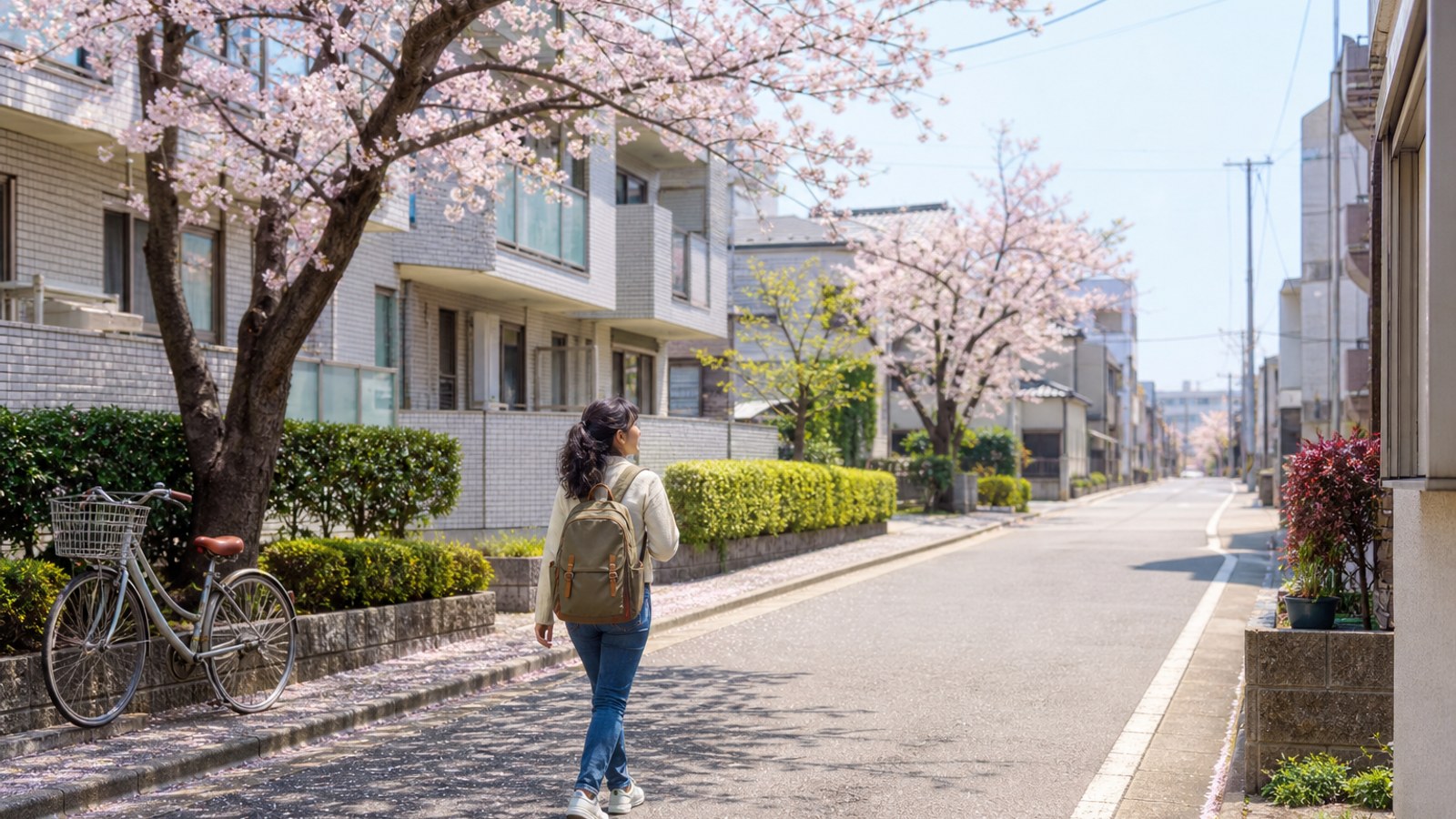
The first week after you arrive in Japan is busy, and it is hard to know where to start. This guide sets out what to do in your first 7 days as a day-by-day guide. Many of the procedures for a Japanese language school and for daily life become easier after you have registered your address.
We checked the official pages listed at the bottom on 8 November 2026. How city offices, banks and mobile phone companies work differs by place and company, and can change. Use this guide as a rough guide, and confirm the actual procedures with your school, the municipal office where you live, and each company.
What to know first
Of the procedures in your first 7 days, the one that needs the most attention as a deadline right after arrival is registering your address (within 14 days of the day you decide where you live). If you are 20 or older, you also have a duty to join the pension system (this is not a "within 7 days" deadline). The "Day 1, Day 2" labels for the other procedures are this guide's rough guide, based on which step comes before which. They are not official deadlines.
Your school may help you with address registration and National Health Insurance together. If so, follow your school's schedule first. Before you leave, it helps to ask your school for "the plan for the week after I arrive".
The 7 days at a glance
| Day | What to do | Details |
|---|---|---|
| Day 1 (arrival day) | Check your residence card. Tell your school and family you have arrived. Move into your housing | "Day 1" in this guide |
| Days 2–3 | Go to your municipal office (the office of your city, ward, town or village). Register your address (move-in notification) and enroll in National Health Insurance. Ask about the pension and My Number at the same time | Procedures After Arriving in Japan |
| Days 4–5 | Open a bank account. Sign a mobile phone contract | "Bank account" and "Mobile phone" in this guide |
| Days 6–7 | Attend your school's orientation and hear the rules for daily life. Check emergency contacts. If you plan to work part-time, check the permission | "School and the rules of daily life" in this guide |
Day 1: Arrival day
- Check your residence card. When you receive it at the airport, check on the spot, with your own eyes, that your name, status of residence, period-of-stay expiry date and work-restriction entry are correct. On residence cards issued on or after 14 June 2026, the "period of stay", "type of permission", "date of permission" and "date of issue" are no longer printed on the card and are recorded only on the IC chip. The "expiry date of the period of stay" and the "work restriction" entry are still printed on the card (Immigration Services Agency). To check information that is not printed on the card, you can use the Immigration Services Agency's Residence Card Reader app. If you do not know how to use it, ask your school. If you could not receive your card at the airport, check the note in your passport and tell your school (for details, see Japan's Immigration Process Step by Step).
- Tell your school you have arrived. At the same time, confirm the plan for the next days (who will help you, where, and with what).
- Keep your important documents together. Do not lose your passport, residence card or the documents from your school. The procedure for losing a residence card is in Procedures After Arriving in Japan.
- Write emergency numbers in your phone or on paper. Ambulance and fire are 119, and police are 110. For details, see the emergency and disaster guide.
Even if you have not yet decided where to live, talk to your school and decide on a place as soon as you can. The 14 days are counted from the day you decide where you live. If you do not register your address within 14 days, you may be fined up to 200,000 yen. Also, if you do not register your address within 90 days of newly landing in Japan without a justifiable reason, your status of residence may be revoked (Immigration Services Agency, Residence Management System FAQ, Q83). For how to find housing, see Finding Housing in Japan.
Days 2–3: Your municipal office
A person who newly comes to Japan must register their address at the office of the city, ward, town or village where they live, within 14 days of the day they decide where they live, bringing their residence card (or, if the passport says the card will be issued later, that passport) (Immigration Services Agency). If you file a move-in notification at the municipal office, it is treated as having made this registration. There is no fee.
If you ask about the following at the same counter, you can avoid going back several times.
National Health Insurance
According to Study in Japan (JASSO), foreign nationals who will stay in Japan for three months or more must join National Health Insurance. You join at the municipal office after registering your address. For how premiums and your share of costs work, see Procedures After Arriving in Japan.
National Pension
According to the Japan Pension Service, all people aged 20 to 59 who live in Japan, regardless of nationality, must join Japan's public pension system (Employees' Pension Insurance or the National Pension). International students aged 20 or over are covered by this description. If you are not in the Employees' Pension, you need to complete the National Pension procedure. Ask the municipal office how to do it. If you are 19 or younger, check again when you turn 20.
Students who find it hard to pay the premiums, for example because of low income, may be eligible to apply for the Student Payment Special Provision. According to the Japan Pension Service, if this provision is approved, payment of your premiums during your studies is deferred (you must apply). It is not an exemption, so you can pay the premiums for the approved period later, within 10 years. The Japan Pension Service page says the following:
- It applies to students of universities, junior colleges, specialized training colleges, miscellaneous schools and similar. A miscellaneous school must have a course of one year or more, and a private one must be approved by the prefectural governor.
- Your income for the previous year must be at or below a set amount. Your family's income does not matter.
- You apply to the national pension counter of the municipal office (city, ward, town or village) where you are registered, to a pension office, or to your school (if the school accepts applications on your behalf). Online applications are also possible. For a paper application, you attach a copy of your student ID or the original of a certificate of enrolment.
- For the deferred period, you can pay the premiums later, within 10 years.
Whether your Japanese language school is covered by this system depends on the type of school, so this guide cannot decide that. If it is hard for you to pay the premiums, do not decide on your own; always consult the counter. This includes how a newly arrived student with no Japanese income in the previous year is treated. Please check with your school and the national pension counter at your municipal office.
My Number
According to the Digital Agency, a My Number is assigned to foreign nationals too, if they have a resident record (juminhyo). It is not notified to people who have no resident record in Japan. When you move to Japan and a resident record is created, a "Notification of Individual Number" is sent to you. This FAQ does not say when it arrives. Ask at the counter when your resident record is created. When the notice arrives, keep it safe so you do not lose it.
Days 4–5: Bank account
According to the Financial Services Agency's multilingual pamphlet "How to Use Bank Accounts and Remittances for Living in Japan" (a Nepali version is available), you can open an account at a bank, shinkin bank, credit union, JA Bank, JF Marine Bank or labour bank.
What you need to open an account
The pamphlet gives the following as examples. What is needed can differ by financial institution.
- Residence card, passport
- A personal seal (hanko). A signature is sometimes accepted instead
- An employee ID or student ID (if you do not have one, the pamphlet advises going to the bank together with someone from your company or school)
When you open an account, and afterwards as needed, the financial institution checks your address, name, period of stay and status, your actual work situation, and so on. If it cannot confirm these, you may not be able to open an account, or may no longer be able to use it. The pamphlet does not say whether the type of account you can open, or the services you can receive, differ depending on your period of stay. Check with the bank before you go.
Registering your address first is thought to make the process easier (this is this guide's rough guide). If you receive a scholarship, check the conditions for the account that will receive the payments in your scholarship information.
Rules for your account
- Contact the financial institution where you opened the account when your address, period of stay or status of residence changes, when you lose your passbook or cash card, and when you leave your job or school.
- When you finish your life in Japan and return to your country, close your account.
- Giving your account to another person is illegal. Also, you must not let someone else use your account after you return to your country. Even if someone asks to borrow your account for moving money, do not agree.
- When you send money abroad, you may need documents that show the purpose and details of the transfer, and it may take time for the money to arrive. Which countries and regions you can send to differs by bank and money transfer provider.
- Banks and money transfer providers that do not hold a licence, permission or registration from the Financial Services Agency are illegal, so do not use them. A list of banks and money transfer providers you can use is available on the Financial Services Agency's website.
The pamphlet, including the Nepali version, is on the Financial Services Agency's page.
Days 4–5: Mobile phone
When you sign a mobile phone contract, the mobile phone company must carry out an identity check on the person signing. According to the Ministry of Internal Affairs and Communications and the National Police Agency guidance (revised April 2026, Reiwa 8), what is checked is your name, residence and date of birth.
Identity documents
- A residence card is one of the accepted identity documents. It is accepted only if it shows your name, residence and date of birth.
- A passport is also an identity document, but if it does not show your residence, you need a supplementary document.
- When the identity document has no residence entry, or the entry is out of date, and your latest residence at the time of the contract cannot be confirmed, a supplementary document is used together with it. Supplementary documents include a receipt for tax payment, a receipt for social insurance premiums, and a receipt for utilities in Japan (electricity, gas, water and so on). The receipt or issue date must be within 6 months of the day of the check.
The way identity is checked differs between signing in a shop and signing online. Signing the contract after registering your address is thought to make confirming your residence easier (this is this guide's rough guide). Ask the shop or company in advance which documents to bring. This guide does not cover price plans or how to choose a company.
What you must not do
- Making a false declaration of your name, residence or date of birth when you sign the contract.
- Handing a mobile phone you are not the contractor of (a phone contracted in another person's name) to someone else, or receiving one from someone else. A violation carries a fine of up to 500,000 yen.
- Transferring a phone in your own name to another person without the mobile phone company's permission. Transferring it for payment as a business carries imprisonment of up to 2 years or a fine of up to 3 million yen.
If someone you have just met in Japan says, "I'll get a phone contract for you, so lend me your name", or "I'll pay you, so sign a contract and hand it over", refuse.
Days 6–7: School and the rules of daily life
- Attend your school's orientation. Ask about attendance rules, how to report lateness and absence, how to put out rubbish, the rules of the place where you live, and so on. How to put out rubbish and on which days differs by municipality.
- Check who to contact in an emergency or when you are in trouble. For illness, injury and earthquakes, see the emergency and disaster guide. If you are in trouble about your visa, part-time work, human rights or daily life in general, the guide to getting help lists services you can use in Nepali.
- If you plan to work part-time, check the permission to engage in activity outside the status of residence. You must not work without that permission. For how to apply and the hour limits, see Part-Time Work for International Students.
What does not have to be finished in 7 days
You do not have to finish everything within 7 days. Complete the address registration, which has a deadline, first. Do the remaining procedures in order, without hurrying, to fit your school's schedule and how busy the counters are. If you do not understand something, ask your school.
FAQ
Do I have to finish all the procedures within 7 days?
No. The deadline to watch right after arrival is address registration (within 14 days of the day you decide where you live). Also check at the counter about the duty to join the National Pension if you are 20 or older. The "7 days" plan is this guide's rough guide, based on which step comes before which. It is not an official deadline.
Can I open a bank account or sign a phone contract before registering my address?
This guide cannot say whether you can. The Financial Services Agency and MIC materials do not say that address registration is required. However, for a phone contract, if your latest residence at the time of signing cannot be confirmed, a supplementary document is needed. Registering your address first is thought to make things easier. Check with the bank or the phone company first.
Can I open an account without a personal seal (hanko)?
The Financial Services Agency pamphlet says "a signature is sometimes accepted". It differs by financial institution, so check before you go.
Do I have to pay the National Pension?
According to the Japan Pension Service, all people aged 20 to 59 who live in Japan, regardless of nationality, must join the public pension system. For students who find it hard to pay, for example because of low income, there is the Student Payment Special Provision. To find out whether a Japanese language school student is covered by the provision, check with your school and the municipal office.
When will my My Number arrive?
When you move to Japan and a resident record is created, a "Notification of Individual Number" is sent to you. The Digital Agency FAQ does not say when it arrives. Ask at the counter when your resident record is created.
A friend asked me to lend my name for a mobile phone contract. Can I?
No. Handing a phone contracted in another person's name to someone, or receiving one, carries a fine of up to 500,000 yen. Refuse.
What to do next
Before you go to Japan, ask your school for "the plan for the week after arrival". You can compare dormitories and costs in the school list. For the full process, see How to Study in Japan from Nepal. If you have questions about how to use this site, please contact us. This site is free to use. We do not guarantee admission or a visa.
Sources
- Immigration Services Agency of Japan: Notification of residence after new landing (mid- to long-term residents)
- Immigration Services Agency of Japan: Procedures at ports of entry and municipal offices (new residence management system)
- Immigration Services Agency of Japan: Residence Management System FAQ (Q83, Q88)
- Immigration Services Agency of Japan: How to read the "Residence Card" and "Special Permanent Resident Certificate"
- Study in Japan (JASSO): Insurance
- Japan Pension Service: Guide to the National Pension for foreign residents
- Japan Pension Service: Student Payment Special Provision
- Digital Agency: My Number system FAQ (A2)
- Financial Services Agency: For foreign residents planning a long stay (bank accounts and remittances, multilingual pamphlet)
- Financial Services Agency: How to Use Bank Accounts and Remittances for Living in Japan (Japanese version)
- Ministry of Internal Affairs and Communications and National Police Agency: Identity checks when signing a mobile phone contract (Act on Prevention of Unauthorized Use of Mobile Voice Communications Services, revised April 2026)
- Immigration Services Agency of Japan
- Study in Japan (JASSO)