
Emergencies and Disaster Preparedness in Japan: Calling 119 and 110, Calling an Ambulance, and What to Do in an Earthquake
Published: · Updated:
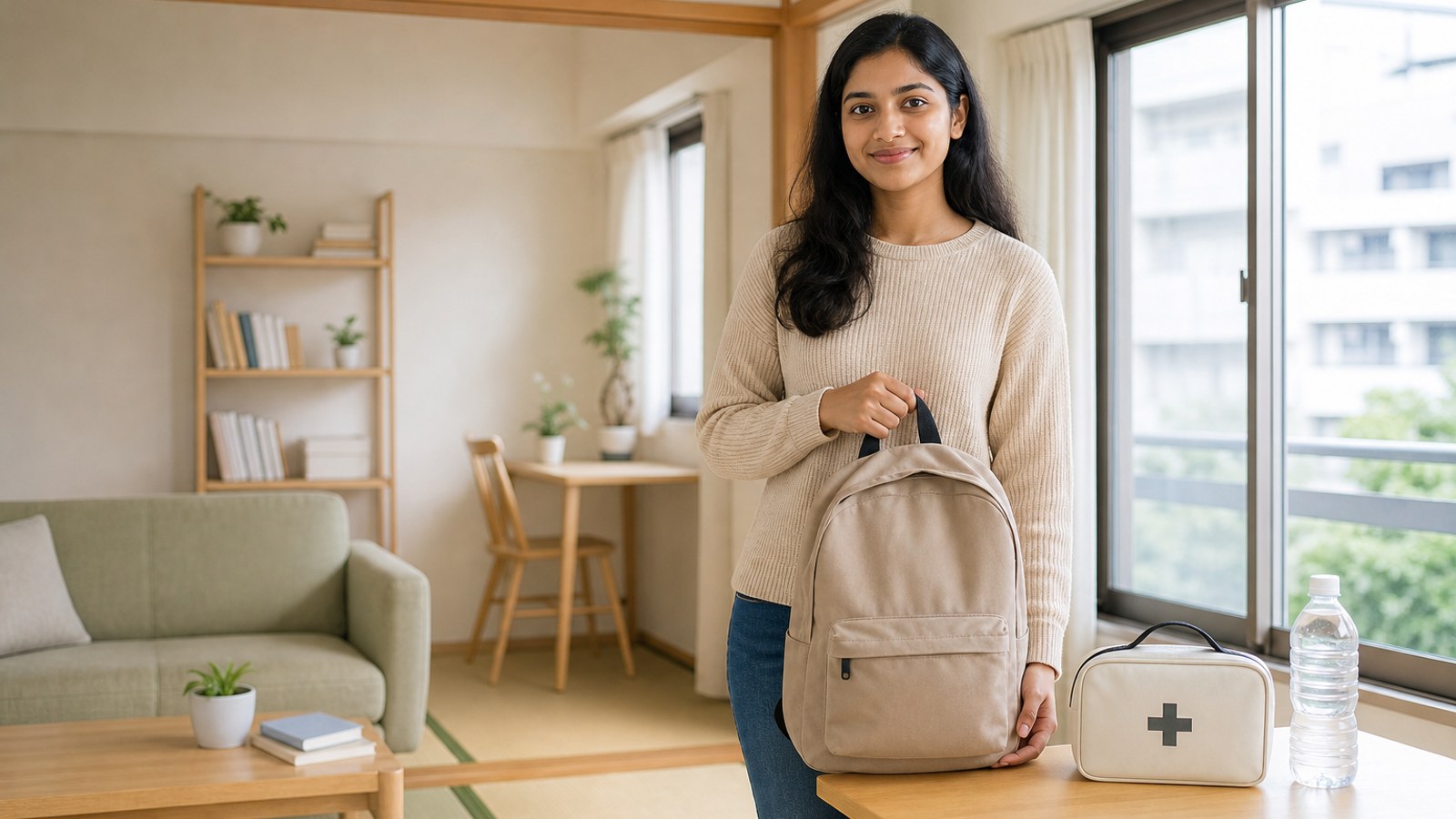
Japan has many natural disasters, such as earthquakes and typhoons. Illness and injury can also happen at any time. While your Japanese is still limited, many people worry about what to do in an emergency. This guide explains, using official information, what is good to know before you arrive: emergency phone numbers, how to call an ambulance, what to do in an earthquake, and multilingual disaster tools.
We checked the official pages and materials listed at the bottom on 7 November 2026. Services can differ by region and change over time. Confirm the actual shelters and contact points with your school and the municipal office where you live.
Emergency phone numbers
- 119: For a fire, and for sudden illness or injury when you need an ambulance. The fire department answers.
- 110: For traffic accidents and crimes such as theft or violence. The police answer.
You can call from a mobile phone, a landline or a public telephone. From a public telephone you can also call 110 and 119 for emergencies. No coins or telephone card are needed. On a public telephone that has an emergency call button (a red button), lift the receiver, press the red button, and then press 119 or 110. On a public telephone without a red button, lift the receiver and dial 119 or 110 directly.
How to call an ambulance
This section is based on the Fire and Disaster Management Agency's "Guide for Ambulance Services." In an urgent illness or injury, anyone in Japan can use an ambulance.
The flow of the call
When you call 119, you are first asked, "Is it a fire or an emergency (ambulance)?" Stay calm and answer slowly.
- Say it is a medical emergency (saying "kyu-kyu" is understood. For a fire, say "kaji").
- Give the location (address). If you do not know the address, give a landmark such as a nearby building or intersection.
- Say who is affected, what the symptoms are and when they started.
- Give the age of the person who is unwell. If you do not know it, give an approximate age.
- Give your name and a phone number where you can be reached.
If the situation is serious, an ambulance may be sent before all the questions have been asked. After you hang up, the ambulance crew may call you, for example if they cannot find the location, so be ready to answer your phone.
If it is hard to explain in Japanese, ask a Japanese-speaking person nearby to take over the call or make it for you. You can also show a nearby person a note or screen that says, in Japanese, "Please call an ambulance" (Japan National Tourism Organization).
Before the ambulance arrives, and when the crew comes
After you call an ambulance, it helps to prepare the following.
- Your passport
- Cash or a credit card (to pay at the hospital)
- The medicine you usually take
If someone is available, have them go to where the ambulance is expected to arrive and guide the crew to you, so it arrives faster. When the crew arrives, tell them:
- What happened to cause the illness or injury
- Any changes before the ambulance arrived
- The most severe symptom, any chronic conditions, and the medicine you usually take
It helps to write down your chronic conditions and regular medicines in a note.
When to call 119 without hesitation
The Agency's guide gives examples of symptoms for which you should not hesitate to call an ambulance. They include being unconscious, blue lips, weak breathing, severe chest pain, a severe headache, convulsions that do not stop, a large burn, a traffic accident with a strong impact, and a fall from a height. There are separate examples for children and babies. If your symptoms are serious or you think your life may be at risk, call 119 without hesitation. If you are unsure whether to call an ambulance, in areas where it is available there is the "Emergency Safety Hotline (#7119)," where a doctor or nurse takes your call (Fire and Disaster Management Agency). The areas that offer it, the ages covered and the hours differ by region, so check for the area where you live.
When you see a doctor
- You generally cannot choose the hospital an ambulance takes you to (Japan National Tourism Organization). The ambulance crew decides based on your symptoms and which hospitals can accept you.
- For non-emergencies, go to a clinic or general hospital during consultation hours. Many clinics accept only cash, while larger hospitals often accept credit cards.
- Some medical institutions in Japan cannot support languages other than Japanese. Before you visit, it helps to ask the institution about language support.
- If you are enrolled in National Health Insurance, your share of insured medical costs is 30%. How to enroll is explained in the guide to procedures after you arrive.
In an earthquake
Japan is one of the countries with the most earthquakes in the world. This section is based on the Fire and Disaster Management Agency's earthquake safety guide and disaster manual and on Japan Meteorological Agency information. An earthquake strikes suddenly, with no warning. The most important thing is to stay calm.
Everyday preparation
- Clear things that could fall or collapse from your bedroom. Make sure nothing can fall onto a sleeping person.
- Fix cabinets, shelves and large furniture firmly to the wall. Use bolts or bonding materials.
- Check that your fire extinguisher works.
- Find out about shelters and evacuation routes. Every community has an earthquake preparedness system. Ask the municipal office where you live about nearby shelters and evacuation routes. Schools and public buildings designated by the municipality serve as shelters.
- Write your address and phone number in Japanese and put it on the wall next to your telephone. This lets you stay calm and tell the operator in an emergency.
While the ground is shaking
- If the house or building is shaking violently, get under a table or other sturdy piece of furniture and wait for the shaking to stop.
- When the shaking stops, or if it is only slight, open doors and windows. They are your way out if the building is damaged or a stronger tremor comes.
- Strong shaking generally lasts no more than about a minute, but it can sometimes last several minutes (Japan Meteorological Agency). While it is shaking, do not rush outside, and keep protecting yourself. Keep away from things that might fall, such as window glass, signboards, shelves and roof tiles.
- Even if you are cooking on a gas burner, protect yourself first while the shaking is strong. When it stops, turn off the burner and close the gas valve. Only if the shaking is slight and you can safely turn it off right away should you do so, without forcing yourself. Never leave the house with the gas on.
After the shaking stops
- Walk slowly and carefully, as there may be broken glass on the floor.
- When you leave home, shut off the electricity and gas. Switch off the main breaker and close the gas valves.
- Listen to radio or television broadcasts and follow evacuation instructions.
- If you are outside, keep away from things that could collapse, such as walls of concrete block or stone.
- If you are near the sea, a tsunami may come. As soon as the shaking stops, move to high ground.
In a large earthquake you may not be able to reach 119. Fire and rescue teams may also not be able to respond quickly because of damage to roads and the large number of calls. That is why each person's own preparation matters.
Multilingual disaster tools (including Nepali)
The CLAIR (Council of Local Authorities for International Relations) page lists multilingual tools that foreign residents can use at shelters. The ones that support Nepali are:
- Multilingual Pointer Board: Boards that help shelter staff and evacuees who do not speak Japanese exchange essential information.
- Multilingual Evacuee Registration Card and FOODPICT: A card that lets you show your physical condition, such as injuries, and your needs, using Japanese translations and pictures. FOODPICT is a set of pictograms for things you cannot eat, such as food allergies.
- My Timeline: A tool for putting together a personal plan of what to do before, during and after a flood.
The Cabinet Office's "Helpful Apps and Websites in the Event of Disaster" also has the Japan Meteorological Agency's multilingual disaster information and guidance on apps. Check each site or app for the languages it supports.
Summer heat (heat illness)
According to the Fire and Disaster Management Agency's guide, summers in Japan are humid and very hot. The temperature can exceed 35°C, and more than 40,000 people are taken to hospital by ambulance for heat illness every year. You can get heat illness even indoors.
- Check the room temperature often. A thermometer helps.
- Use an air conditioner or fan to keep the room temperature from going above 28°C.
- Drink water even when you are not thirsty.
- When you go out, wear cool, loose clothing and use sun protection.
- Do not overdo it, and take breaks.
If you cannot drink water or move by yourself, call an ambulance without hesitation.
What to do before and after you arrive
- Ask your school for an emergency contact (a school staff member) and the nearest shelter.
- Write your address and phone number in Japanese and put it next to your telephone.
- Write down your chronic conditions and the medicine you usually take.
- Enroll in National Health Insurance (if you will stay three months or more).
- At the municipal office where you live, check shelters and evacuation routes.
- Save links or shortcuts to the Japan Meteorological Agency and other multilingual disaster information on your phone.
Frequently asked questions
Can I call an ambulance if I do not speak Japanese?
Yes. Call 119, say it is a medical emergency, and give the location. If it is hard to explain, ask a Japanese-speaking person nearby to make the call.
How do I choose between 119 and 110?
Use 119 for fires and sudden illness or injury. Use 110 for traffic accidents and crimes. If someone is injured in a traffic accident, call the police on 110 and, if needed, also call an ambulance on 119.
Should I run outside as soon as an earthquake starts?
Do not rush outside. If the shaking is strong, get under a sturdy piece of furniture and wait for it to stop. When it stops, open a door or window to make an escape route.
Where is my shelter?
It depends on the municipality where you live. Ask at the municipal office or your school for the nearest shelter and evacuation route.
Can I choose the hospital an ambulance takes me to?
In principle, no. The ambulance crew decides based on your symptoms and which hospitals can accept you.
What to do next
When you choose a school, it also helps to ask about emergency contacts and the disaster rules for dormitories. See How to Choose a Japanese Language School and the school list. For housing, there is the guide to finding housing. If you need help, contact us. This site is free to use. We do not guarantee admission or a visa.
Sources
- Fire and Disaster Management Agency (FDMA): Guide for Ambulance Services (English)
- FDMA: Disasters: A Safety Guide - Earthquakes
- Japan National Tourism Organization (JNTO): Guide for when you are feeling ill
- CLAIR: Disaster preparedness materials (multilingual)
- Cabinet Office: Helpful Apps and Websites in the Event of Disaster
- FDMA: Emergency Safety Hotline (#7119)
- Japan Meteorological Agency: How long earthquake shaking lasts (FAQ)
- FDMA: Earthquake disaster manual (after the shaking stops, initial fire fighting)
- Immigration Services Agency of Japan
- Study in Japan (JASSO)