
Train Rules Newcomers to Japan Should Know: Priority Seats, Phone Calls, Luggage, Boarding and Getting Off, Women-Only Cars, IC Cards, Delay Certificates, Lost Property and Where to Get Help After Groping
Published: · Updated:
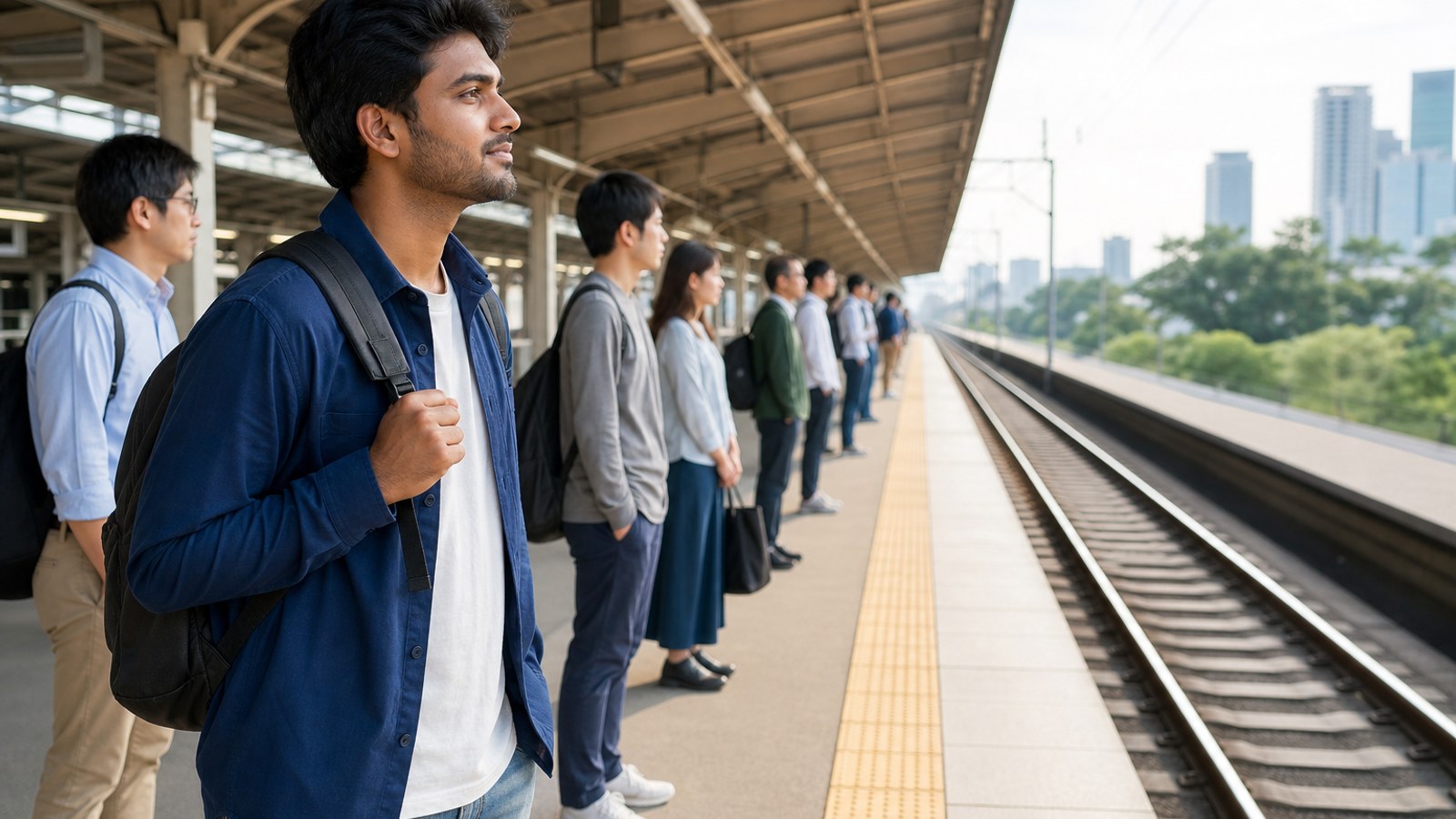
In Japan, the train is a daily way to get to school and to your part-time job. Stations in the morning are very crowded, and everyone is quiet. At first you may wonder, "Why is nobody talking?" This guide explains, based on official information, the basics for spending time comfortably with the people around you on trains and in stations.
We checked the official pages listed below on 10 November 2026. Train rules differ a little between railway companies and regions. Where this guide mentions a company by name, that is an example from that company. On the line you use, first look at the notices in the station and on the train, the announcements, and the company's official website. The main information about rules and railway company guidance is based on what we confirmed on the official pages. Where we could not confirm something on an official page, the text says so where needed.
This guide covers only train manners and what to do when you are in trouble. For how to get from Narita Airport to your school, see the guide to getting from Narita Airport to your school or home. For the first procedures after you arrive, see the guide to your first 7 days in Japan.
What to know first
- Most train manners are presented as requests, so that everyone can use the train comfortably. However, some acts, such as groping (chikan), are crimes.
- If you are not sure, ask a station staff member.
- The Japan Private Railway Association (Mintetsu) runs a survey every year on manners in stations and on trains. In fiscal 2025, 5,202 respondents chose the acts they find bothersome. This survey is a clue to which behaviors bother people who use Japanese railways.
1. Acts people often find bothersome, according to the Mintetsu survey
In the Mintetsu fiscal 2025 survey, the items most relevant to this guide among the acts people find bothersome were as follows (up to 3 answers each).
| Rank | Act | Share |
|---|---|---|
| 1 | Coughing or sneezing without consideration for others | 34.7% |
| 2 | How people sit (not moving over, stretching legs out, etc.) | 31.9% |
| 3 | Noisy conversation and rowdy behavior | 30.2% |
| 4 | Staying near the doors | 27.6% |
| 5 | How people use smartphones (using them while walking, using them in crowds, etc.) | 21.6% |
| 6 | Strong scents (perfume, detergent, fabric softener, cosmetics, etc.) | 21.5% |
| 7 | How bags and umbrellas are carried or placed | 20.1% |
| 8 | Manners when boarding and getting off (rushing onto the train, cutting in line, etc.) | 20.0% |
The same survey also had a question about foreign visitors to Japan. The most common answer was "noisy conversation and rowdy behavior" (69.1%), followed by "how bags are carried or placed" (41.9%) and, third, "how people sit" (26.2%). Mintetsu explains that answers gathered around behaviors that tend to happen when people are not used to the railway.
This is not a list of "things you must not do." These numbers show what the people around you in a Japanese train tend to worry about. The chapters below explain, with reasons.
2. Boarding, getting off and the platform
In the Mintetsu survey, the acts people found most bothersome when boarding and getting off were, in this order:
- Not moving away from the doors (blocking people getting on and off, not moving further inside). 26.6%
- Getting on without waiting for people to get off. 22.9%
- Cutting into the boarding line. 18.9%
- Rushing onto the train. 18.2%
Reason: If the people getting off cannot get out first, boarding and getting off take longer. Mintetsu explains that staying near the doors, especially when the train is very crowded, blocks other people's movement, makes the train stop longer at the station and can lead to train delays.
In practice, the following makes things go smoothly.
- On the platform, stand at the back of the line.
- When the doors open, first wait for the people getting off.
- If there is space further inside, move in instead of staying in front of the door.
- If the departure bell is ringing, wait for the next train.
JR East explains that it works to improve manners on trains with posters in stations and on trains and with announcements in stations and on trains.
Using a smartphone while walking was, in the Mintetsu survey, the most bothersome of the ways of using a smartphone (39.1%). On station platforms and stairs, stop first and then look at your phone; there is then less risk of bumping into someone.
3. Priority seats
According to the Ministry of Land, Infrastructure, Transport and Tourism (MLIT) material from its "Guidelines for Barrier-Free Improvement of Public Transport," the pictograms (symbols) for priority seats show the following five groups.
- Older people
- People with disabilities and people who are injured
- Pregnant women and women who have recently given birth
- People with infants and small children
- People with internal impairments (disabilities that cannot be seen from the outside)
Priority seats are placed near the doors so that the walk when getting on and off is short. The MLIT material gives examples where the color of the seat and of the nearby straps or wall is changed so that the seats can be recognized from inside the car.
The MLIT material also introduces the "Help Mark" (ヘルプマーク). The Help Mark is a sign worn by people who need assistance or consideration, to let those around them know. Some people have difficulties that cannot be seen from the outside. If there is such a person near the priority seats, please think about giving up your seat. In the Mintetsu survey too, "priority seat manners" appears among the bothersome acts (8.9%).
Giving up your seat and speaking up
The MLIT "Hospitality Guidelines for Public Transport Operators" say that when you see someone who seems to be in difficulty, you speak to them with "Is there anything I can help you with?" and check whether help is needed. If the person says they need help, assist them in the way they want, in principle. These guidelines are for railway staff, but the way of thinking is a useful reference for anyone. If Japanese is difficult, even just saying "Are you OK?" can show that you care.
4. Mobile phones and sound
According to JR East, 37 railway companies in the Kanto, Tohoku and Koshinetsu regions, including JR East, have used unified guidance since 1 October 2015. It is as follows.
- Near priority seats, switch off your mobile phone when the train is crowded.
- Elsewhere, set your phone to silent (manner) mode and refrain from phone calls.
Guidance may differ by region and company. Reason: The inside of a train is narrow, and your voice on a call is heard by the people around you just as it is. If you need to make a call, do it after you get off the train, and you will not bother the people around you.
Reading text messages silently is probably less noticeable than a call, but please keep it modest while walking, while boarding or getting off, and in a crowded car. In the Mintetsu survey, "noisy conversation" ranked third, and "sound leaking from headphones or earphones" is also an item (9.8%). When you ride with friends, keep your voices low, and it is easier for the people around you.
5. Luggage and how to carry a backpack
In the Mintetsu survey, the ways of carrying luggage that people found most bothersome were as follows.
| Act | Share |
|---|---|
| Carrying a bag on your back | 27.7% |
| How umbrellas are handled (wet umbrellas, pointing the tip at others, etc.) | 18.2% |
| Holding a bag in front of your body | 17.6% |
| How carry bags (wheeled suitcases) are handled | 10.4% |
| Putting it on a seat | 9.2% |
| Putting it on the floor (at your feet) | 6.8% |
Reason: In a crowded car, some people feel that a backpack hits other people. On the other hand, some people feel that holding a bag in front takes up space. In other words, there is not just one "right" way to carry it. When it is crowded, the most important thing is to keep your luggage small and compact so it does not bump into people around you. Putting luggage on a seat causes trouble when there are people who cannot sit.
10.4% of people also chose carry bags as the most bothersome act.
6. Eating and drinking, smells, and so on
The Mintetsu survey also includes "eating and drinking in a crowded car" (7.5%), "leaving trash, PET bottles and so on behind" (12.9%), "strong scents (perfume, detergent, fabric softener, cosmetics, etc.)" (21.5%) and "putting on makeup on the train" (7.9%). These are listed not because every train has a rule banning eating and drinking, but as acts that bother the people around you in a crowded car. Guidance may differ by type of train and company, so look at the notices on the train you ride.
7. Strollers, wheelchairs and people with physical disabilities
The MLIT "Summary of the Council on the Use of Strollers on Public Transport" (March 2014) says that because many different people use public transport, it is necessary to deepen mutual understanding and use it while giving way to each other little by little. For people using strollers and for the people around them, the space inside the train is important.
The summary also says that whether to fold a stroller and where to put it differ by operator. This material is from 2014, so check the current guidance on the official website of the company you ride.
The face of a person using a wheelchair is at about the chest height of a standing person. The MLIT hospitality guidelines say that when it is crowded, you need to be careful about position and direction so as not to bump into luggage or the people around. Near wheelchair spaces and elevators, do not stand still; make way.
8. Women-only cars
A women-only car is a car that a railway company provides, for example during the morning commuting and school hours, so that women can ride with peace of mind. The company, line, hours and car position differ by company. Taking Seibu Railway as an example, it is introduced during weekday morning commuting and school hours, and the stickers on the platform and on the car windows are the sign. Besides women, the following people can also ride, according to its guidance.
- A man with a physical disability riding alone
- A man accompanying a person with a physical disability to assist them
- A boy of elementary school age or younger riding alone
- A male guardian riding with a child of elementary school age or younger
It may be suspended when the timetable is disrupted. Men should check the hours and the stickers on the platform, and avoid that car. MLIT answered at the Hotline Station in 2015 that women-only cars are run with the understanding and voluntary cooperation of users and have no legal basis. For this reason, if you board one by mistake, a station staff member may speak to you. When you notice, please move to another car at the next station.
9. Tickets and IC cards
According to the JR East FAQ, when the balance on your Suica is not enough, do the following.
- Top up and use it, or buy a ticket at a ticket machine by adding cash.
- If your balance runs short after you have entered the ticket gate, top up, or top up the shortfall, at a fare adjustment machine.
- If it runs short when shopping, you cannot top up in the shop except at some shops. Top up beforehand at a ticket machine or similar.
Suica has a fixed area where it can be used. If you ride beyond the area, tell the station staff at the station where you get off and pay the fare in cash. If you are going beyond the area, buy a ticket first. For the usable areas and how they relate to the IC cards of other companies, check the guidance of the company in the area where you live. This guide does not write about types of cards, prices or student commuter passes, because there was nothing within what we could confirm. Please ask at the station counter.
10. When you are delayed: the delay certificate
When a train is delayed, your school or part-time workplace may ask you for a "delay certificate" (遅延証明書). In the JR East example, it is as follows.
- It covers ordinary trains on conventional lines that were delayed by roughly 5 minutes or more. Limited express, extra, group, freight and out-of-service trains are not covered.
- For major lines in the Greater Tokyo area, delay certificates for the past 45 days can be issued on the website.
- The certificate shows the largest delay that occurred on that line. It does not certify the delay of an individual train or that you rode it.
- For lines outside the Greater Tokyo area, with some exceptions, certificates are issued on a site called "Dokotore."
Other railway companies also have delay certificates. Check the official website of the company you use. If you are likely to be late, contact your school or part-time workplace early. For the rules on part-time work, see the part-time work guide.
11. When you lose something
According to JR East, lost property found in stations and on trains is registered in a system and kept for a set period. Items that are not collected are handed to the nearest police station or similar.
- Inquiries about lost property are accepted through the lost property inquiry chat "find chat," by phone at the JR East inquiry center (lost property), or at a station.
- When you inquire, tell them the date, time and place you lost it and the features of the item (color, shape, contents and so on) in as much detail as you can.
- It can take time before an item is registered in the system. If it is not found, inquire again after some time.
- The storage period differs by station.
- The person who found it may also hand it to a police station or to another railway company with through service. Ask there too.
If Japanese is difficult, show the station staff the lost item and the line and station you rode, for example on your smartphone screen. For a train of another company, ask at that company's station or on its official website.
12. If you are a victim of groping (chikan)
The National Police Agency explains that groping (chikan) and secret photography are serious crimes. It asks victims and witnesses to report or consult right away. A victim is not at fault. The guidance on the National Police Agency page is as follows.
- Ask the people around you for help. Ways include raising your voice and using a crime-prevention app.
- When you are safe, call 110 right away. Even if time has passed, it is fine to consult the police.
- When you call 110, calmly tell them one thing at a time: what happened, when and where it happened, how the harm occurred, and the offender's appearance and clothing.
- The police carry out the investigation with consideration for the victim's emotional burden. As far as possible, they make arrangements so that an officer of the gender the victim wishes listens to them.
If you witness it, speak to the victim with "Are you OK?" and let a station staff member or the police know.
The places to consult that the National Police Agency lists are as follows.
| Where | What for |
|---|---|
| 110 | Crimes and emergencies |
| #8103 (sex crime victim consultation line) | Connects you to the sex crime consultation desk of the prefectural police for the area you call from |
| #8891 (one-stop support center) | Medical support, consultation and counseling, accompaniment to the police, etc. |
JR East also explains that it deals with criminal acts such as groping in cooperation with the Railway Police Unit. In an emergency, call 110 first. If you are unsure about Japanese, tell a person nearby or a station staff member "Please call 110" or "Police, please." For non-urgent consultation, or for consultation some time later, you can also use #8103, #8891, or your school or local consultation desks. Desks that can be used in Nepali are in the guide to where to get help. For what to do in an emergency, see the emergency guide.
Groping and secret photography are crimes. In Japan, in a crowded train, your body or belongings may touch someone. Take care where your hands and bags are, and do not make the other person feel uneasy. Also, this guide does not write about how to respond when you are wrongly suspected, because we could not confirm it in public materials. If you are in that situation, consult your school or the desks in the guide to where to get help right away.
FAQ
Can I talk a little on the train?
In most cases, a small voice is fine. In the Mintetsu survey, "noisy conversation and rowdy behavior" was third among the acts people find bothersome. For phone calls, JR East and others ask people to refrain.
If a seat is empty, may I sit in a priority seat?
The official materials used for this guide did not say whether you may sit there when it is empty. Priority seats are for older people, people with disabilities, people who are injured, pregnant women and women who have recently given birth, people with infants and small children, people with internal impairments, and so on. When someone who needs the seat is there, give it up. Some people cannot be recognized by their appearance, so if you see a Help Mark, pay attention.
Is rushing onto the train not allowed?
In the Mintetsu survey, among boarding and getting-off manners, rushing onto the train bothers 18.2% of people. Mintetsu explains that delays in boarding and getting off can lead to train delays. Waiting for the next train lets you board more calmly.
What do I do if my Suica balance is too low and I cannot leave the ticket gate?
Top up at a fare adjustment machine. If you are not sure, speak to a station staff member (JR East FAQ).
What to do next
It is reassuring to check in advance, on the official website of the company whose line you use, how to get a delay certificate and whom to ask about lost property. Get into the habit of checking your IC card balance before you go through the ticket gate. For your commute, ask your school about it and check the crowded hours. For the first procedures after you arrive, see the guide to your first 7 days in Japan, and for getting from the airport, the guide to getting from Narita Airport to your school or home. In the list of Japanese language schools you can compare each school's conditions. If you have a question about how to use the site, please contact us. You can contact us, but we do not guarantee admission or a visa. This site is free to use.
Sources
- Japan Private Railway Association: Fiscal 2025 ranking of bothersome acts in stations and on trains
- MLIT: On promoting the proper use of priority seats (excerpt from the barrier-free guidelines, reference material)
- MLIT: Hospitality guidelines for public transport operators (March 2024)
- MLIT: Summary of the Council on the Use of Strollers on Public Transport (March 2014)
- Ministry of Internal Affairs and Communications: Results of administrative consultation on women-only cars (including the reply from the MLIT Hotline Station)
- JR East: Manners for using mobile phones on trains (FAQ)
- JR East: Efforts on train manners and violent acts (FAQ)
- JR East: When the Suica balance is not enough (FAQ)
- JR East: When you ride beyond the Suica usable area (FAQ)
- JR East: Delay certificates
- JR East: About past delay certificates (FAQ)
- JR East: Where to inquire about lost property in stations and on trains (FAQ)
- JR East: Lost property storage period (FAQ)
- Seibu Railway: Women-only cars
- National Police Agency: Measures against groping and secret photography
- Immigration Services Agency of Japan
- Study in Japan (JASSO)